British protestant missionaries believed a nation originated from a group of people who had the Bible translated into their own vernacular.
This seems to be the case in Hong Kong, albeit with a 100-year time lag.
Cantonese with its Hong Kong characteristics has been a defining feature of the emerging Hong Kong identity.
Cantonese has become the lingua franca of Hong Kong, despite the fact that only about a half of the population of the British commercial enclave was from Canton, the rest coming from various linguistic backgrounds, including the local dialect which significantly differs from Cantonese.
This was probably due to the influence of Canton traders who had a history of trading with western merchants.
The Brits apparently kept the lessez-faire attitude to language matter in the territory, partly in fear of Chinese nationalism, whose medium was Mandarin, seeping in across the border.
Fast forward to 90s and 00s: Very few residents felt they were anything other than "Hong Kong Chinese."
However, since it became clear that Beijing didn't honor One Country Two Systems formula in the 10s, more and more Hongkongers started to be attracted to Hong Kong independence movement, hitherto unpopular.
One of the things that made them really feel they were different from the rest of the world was their lingo, now increasingly in its written form, spread wide thanks to informal publications like magazines and comics.
The Bible didn't result in a Canton Nation, but a people seem to be emerging, at least partly thanks to the language policy (or lack thereof) of the British.
Teochews are an interesting group of people among the overseas Chinese, whose ancestral land overlaps with that of Hakkas in the eastern part of Guangdong. Today, the main city is Swatow (Shantou) but it used to be Chaozhou in the past, from which the name of the group derive.
Although geographically from Guangdong, the Teochew language is closely related to Hokkien. Teochew spoken in places like Singapore is mutually intelligible with Hokkien, perhaps because it has been under the heavy influence from the latter, who form the majority there. But I heard that Teochew spoken in Swatow today is not readily intelligible to Hokkien speakers from Amoy.
The majority of ethnic Chinese in Thailand and Cambodia are Teochews, and even the royal family of the former has some Teochew ancestry.
The first Teochews who came into personal contact with me was a refugee family from Cambodia at the Chinese mass community back when it still met at Sophia University. That made me realize that the family running my favorite restaurant Cambodia in Takadanobaba actually was also Teochew.
The Singaporean exchange student I met also at the Chinese mass was also Teochew, and so was the family I stayed with when I was in Johor Baru, Malaysia, on my way to the UK back in 1992.
While I was in Hull, I once visited a Singaporean lady who married with a local English person. I remember she was also Teochew. The wife of one of my best friends from my Hull years is also Teochew, who come from an area close to Thai border on the east coast of Malaysia. Since Teochews from the majority of Thai Chinese, her family might have also moved from Thailand.
By the way, Mr. Li Ka-shing, one of the richest tycoons in Hong Kong, is also a Teochew and there's a YouTube video of him speaking in Teochew. Unfortunately, he is not a personal friend of mine.
Do you have any Teochew friends? Tell me about them.
A mass of evidence supports that using learners' first language is helpful for their learning of a second language. That's why a bilingual local teacher is much superior than a monolingual foreign one. Education experts in Hong Kong are now advising teachers to use Cantonese effectively in English classes. In the past, only English was to be used. A bit of common sense is enough to understand why it is much more efficient to use students' first language when teaching some abstract concepts or tongue positions in pronunciation, etc. Why, then, is it that monolingual foreign teachers are still so valued in Taiwan?
Aside from strong parental support for white teachers, hence the need for white faces on prospectuses, I think "supposedly" monolingual teachers are valued precisely because they are considered "English-only" teachers. I say "supposedly" because I know most of the foreign teachers are multilingual and can speak Mandarin very well, but Taiwanese people "presuppose" that only English is to be used upon seeing a white face. Learners will feel obliged to speak English, which they won't in the case of a local teacher. They feel awkward to be speaking in English to a teacher whom they know they can communicate much more efficiently with in Mandarin. Thus, they accomplish the goal of practicing spoken English better with "monolingual" white teachers than with bilingual local teachers.
On the other hand, some Taiwanese people seem to presuppose that people with East Asian faces necessarily speak Mandarin, and therefore it is awkward to be speaking English to them. I'm Japanese and I'm in a classroom where the medium of instruction is supposed to be English. So it should be natural that they should be talking to me in English. But when I try to talk to them in English, they tend to insist on using Mandarin in response. It's sometimes REALLY hard to get them to say any English word, even just "yes". They would insist on saying "對" instead! What a contrast with a Caucasian colleague of mine, who speaks better Mandarin than I do! I often overhear students doing their very best to answer him in English, even though the question was just asked in Mandarin?
Is it just me? Is it because I don't look at all like a non-Mandarin-speaker? Would they try to speak to me in English if I looked more stereotypical Japanese, with an anime hairdo and really tight clothing? (Thank you, Lauren, for your advice!) What about ethnically Chinese teachers who grew up overseas? Since their surnames sound Chinese, wouldn't people expect them to speak Mandarin all the more?
I used to laugh at my mother who said in her blog posts almost everyday that she had spent the whole night writing a long post, and then it got deleted. Now the same thing has happened to me. Two lessons: First, you should not laugh at others, especially your own mother; Second, when you have written a post, publish it quickly. To do this, don't write posts that are so long that it needs to be reviewed before publishing.
Is not promoting a language the best way for the authorities to promote a language? I sometimes think it is. I'll show you two examples: Hong Kong and Taiwan.
The British authorities had a so-called laissez-faire approach toward languages in Hong Kong. But I have already written that this was a hidden way of promoting Cantonese, so that Hong Kong will have a different dominant language from mainland China. Although Cantonese-speaking people made up only half of the total population, it was possible to foresee that Cantonese would win out, given its influence in commercial and cultural spheres. In fact, Cantonese was so successful that it almost supplanted the local language of Hong Kong, Hakka, as well as other Chinese "dialects" originally spoken. Today, you could argue that Hong Kong is a pseudo-monolingual society in Cantonese. It is a symbol of Hong Kong identity, which is separate from that of mainland China. What a successful way of promoting Cantonese? And this was achieved by not promoting it.
Taiwan's example is somewhat reverse. Both the Japanese and KMT administration had very high-handed policy of trying to eradicate local languages and promoting Japanese and Mandarin respectively. They both did it by forcing those schoolchildren who transgressed the no-local-language policy to wear a dog tag that said something like "I am stupid". Intimidating local people succeeded in promoting the official language only superficially. Many Taiwanese people who grew up in that era, consciously or unconsciously, try to speak Mandarin with a very strong Taiwanese accent. Some even try to avoid the use of Mandarin altogether, sticking to Hokkien whenever they can. On the other hand, look at the younger generation who grew up after the democratic reform. The aggressive promotion of Mandarin was replaced by so-called "Mother Tongues" made a school subject. And yet, those people have now become native-speakers of Mandarin, fully comfortable with expressing their Taiwanese identity in this tongue that originated from Beijing! Recently, I often notice that some students even use the word "Taiwanese" to mean Mandarin, not Hokkien!
And what has happened to Hokkien, which is now "officially promoted" as a school subject? I'm sorry to say, but it seems that it is going the way of Irish in Ireland. Very soon, Taiwanese people will only be able to say some peculiar phrases and swear words in Hokkien, or hum some Hokkien tunes like "TiN-o'-o'" which they have learned at school, but not being able to convey any substantial message in Hokkien.
(But this will not mean the death of Hokkien; more than half of its speakers are outside of Taiwan; in China, Southeast Asia and Taiwanese communities in the U.S. and Japan. They will probably keep alive the language which will no longer be understood in Taiwan!)
Some years back, I was attending a conference in Taiwan, listening to a senior Taiwanese scholar present on the Received Pronunciation (RP). It is roughly the same as "BBC accent" or "posh Southeastern English accent". The presenter said only 1% of the British population spoke with such accent. And yet he recommended it be taught to learners in Taiwan. So, during the Q&A session, I asked: If there are so few people using it, why should we teach it? Then my boss sitting next to me covertly reminded me that it was impolite to ask questions to senior presenters during Q&A sessions, so I backed off.
And to answer this question now myself, I think there is still a value in exposing learners to the RP, even though it's a dying (?) accent in England.
Even though RP has long lost its prestige in England, it is still widely taught to "foreigners", especially in Europe. So you are likely to come across a second-language speaker of English with an RP-inspired accent. In Hong Kong, Singapore, India and other Anglophone countries in Asia (with the exception of the Philippines), the teaching model at schools still derive from the RP. But many Taiwanese learners, especially those at lower proficiency levels, are quite unfamiliar with anything other than the idealized General American pronunciation. So they find it rather hard to understand second-language speakers who have learned British English back in their home countries.
Despite the fact that its speakers are considered "affected" and "cold" within the UK itself, the RP is a well-documented accent. There are many dictionaries and ESL textbooks that use this pronunciation, including authoritative ones like Daniel Jones's English Pronouncing Dictionary. Those are handy for teachers when they are not sure about pronunciation. On the other hand, most American dictionaries don't prescribe any one particular pronunciation. The phonetic symbols they use are designed to allow room for variation. Although language is and always will be varied (and that's the beauty of it), but that's not necessarily a comfortable situation for teachers looking for something "definitive". (Especially so for "non-native" teachers, who feel insecure for their perceived lack the authoritativeness as an authentic source of English.)
Plus, the RP has retained its prestige, in out of all places, America. I've seen many TV programs, commercials and movies where (fake) posh British accent is used for some supposedly positive effect. Even though very few people in Britain actually speak like that, Americans seem to associate it with some kind of fancy/fanciful European stuff. So if you are thinking of going to America, having an RP sort of accent might help. I must add though, that this might not apply if you are not European. My experience is that some Americans are not as favorable to non-whites with a British-derived accent. Maybe they notice you look like a foreigner and have an "unusual" accent, so they just conclude that you have a "foreign" accent. (Across the border in Canada, though, I notice that some people expect "foreigners" to be taught British English, even if their own variety is so much closer to that of the US.)
But in the context of Taiwan, all I'm saying is we should expose learners more to different accents including the RP, which is quite useful because it's taught to international learners. I'm not saying that they should all try to sound like the Queen with an exaggerated "aristocratic" intonation. Don't do this all the more if you are going to the UK. There, people with regional working class or black accents are considered cool nowadays. I'm saying that you will find it becomes easier for you to understand people from many different countries speaking English, once you are familiar with what they are being taught at school: the RP.
I've wanted to write about this for a long time, but never found the time to do so.
I found this study about rhoticity in Singapore English (http://www.icphs2011.hk/resources/OnlineProceedings/RegularSession/Tan/Tan.pdf). In a nutshell, it found that many people in Singapore consider rhoticity (pronouncing the /r/ in words like "car" and "cart") to be a sign of good education and higher social status.
I was wondering about this for a long time. When I was living surrounded by Singaporeans about 20 years ago, none of them had a rhotic accent. Then I came across some very fashionable Malaysian students who tried to sound rhotic, seemingly in an attempt to appear "Americanized" and "cool". And recently, I started listening to Singaporean talk shows on internet radio, and noticed that more and more seemingly "upwardly mobile" people, especially female, are starting to "roll the r".
This is interesting because, from what I know, in southern England, having a rhotic accent is considered a sign of being a country bumpkin rather than hip and cool. (You sound like you are from Ireland or West Country or somewhere like that if you pronounce the "r". Even people in Lancashire don't do that anymore, you know!) So this is another sign of increasing dominance of American English even in traditionally British-oriented outer-circle Asia (minus the Philippines, of course).
Now, when I attended the IAWE conference in Hong Kong last year, there was a linguist from Hong Kong saying that some younger Hong Kong speakers are going rhotic due to the influence of the American media inputs. This is hardly surprising because many of the DJs and personalities on English channels of RTHK have north American accents. And if I'm not mistaken, among the expat communities in Hong Kong today, there are more Americans and Canadians than Brits.
I asked him if this could also be because many Hong Kong families hire Filipino helpers to take care of their children. In fact, quite often, those helpers are the only people with whom many Hong Kong children converse in English, so it would not be a surprise if Hong Kong youngsters picked up the Philippine rhotic /r/ from them, even if they are still taught the non-rhotic RP at school. But the linguist in question categorically denied this possibility. I was not quite convinced. Maybe some research is needed.
It's been such a long time since I last took a train in China. Looking forward to the trip!
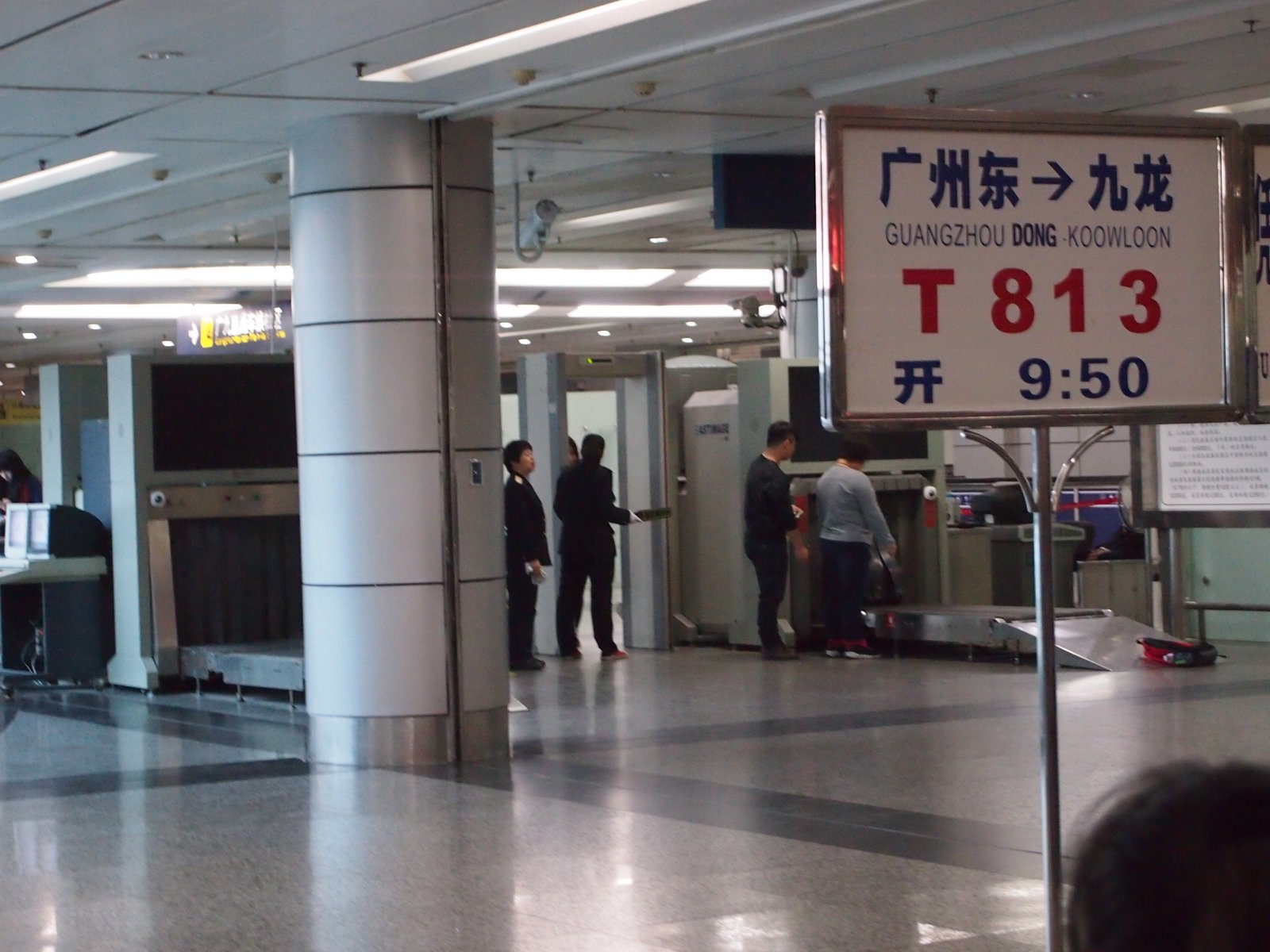
Fast food restaurant in Guangzhou train station was Chinese style with Bruce Lee on the sign.
The "international" train to Hong Kong leaves from upstairs. Saw many adverts for "男科醫院" here...
Never heard of 男科 in other countries...!
Waiting for the immigration gate to open. Come to think of it, this is my first time crossing a boarder on a train.
There are two kinds of trains between Guangzhou and Hong Kong. The China ones and Hong Kong ones.
Of course, I chose the China one!
Hong Kong trains use made-in-Japan carriages and it would be the same as any other ordinary train ride experiences.
I'm glad that the Soviet style uniforms are still alive!
I hope they won't "modernize" those communist-style uniforms because they are one of the tourist attractions for foreigners.
Although it's also true that British-style uniforms in Hong Kong do look good!
"Ruanzuoche"
Very comfortable.
I love the color of seats and the design of the carpet!
It would just be the same as any train anywhere in the world without those Chinese characteristics.
No more conductors distributing hot water with a big kettle! (Sayang!)
It would have been more environmentally friendly than distributing bottled water, which many passengers don't drink anyway.
In China, people USED TO bring their own cups. In other countries, people are JUST STARTING to do so for environmental concerns.
By the way, I was told off by this conductor for taking pictures in the train!
A much more modern and faster train that connects Guangzhou with Shenzhen.
Guangdong must be one of the best part of China. Clean and green!
Such a stark difference from typically arid and dusty landscape of the rest of mainland China!
Arrived in Shenzhen.
This ultra-modern city used to be a sleepy farming village until Deng Xiaoping came here in the early 80s.
Crossing the boarder! On the right is the China side.
The ultra-modern city landscape of China turns into a squeeky clean natural-park style countryside once the train enters Hong Kong.
In my opinion, one of the best legacy of the British rule in Hong Kong is the separation of commercial/residential areas with natural reserves.
If this was in Taiwan (or in mainland China for that matter), those green hills would already be teeming with fake-European-style residential towers, hot spring resorts, night markets and graveyards.
Arrived at Kowloon station (Hung Hom).
I realy like the traditional Chinese fonts used for signs in Hong Kong MTR. They are traditional, yet modern.
Hung Hom station looks like one of the more modern train stations in Europe. Big glass windows and metal roofs are really unsuitable for tropical weather and wastes a lot of electrcity for airconditioning.
But I think the European aesthetics are still very much alive in Hong Kong. And they have enough money to afford to look good, I think!
(Video: People in Hong Kong and Guangzhou rallying in defense of Cantonese. In my impression, Cantonese is still very robust in the Pearl River Delta; people could perhaps be a bit oversensitive due to the massive influx of migrants from other provinces.)
I used to feel relieved to cross the Hong Kong-China border
over to Shenzhen, because I was finally getting out of the strange (to me) environment
of Cantonese and going back into the familiar Mandarin-speaking environment of Shenzhen.
Shenzhen could be one of the most Putonghua-friendly cities in China. The
majority of its citizens come from many different provinces. So although it
used to be a Cantonese and Hakka speaking small town in the past, many people
you come across in Shenzhen today don’t speak much Cantonese. (It seems,
though, that speaking Cantonese is considered fashionable among some young
people who grew up in Shenzhen regardless of where their parents come from.
This is probably because of the Hong Kong influence. It is entirely possible that there will be a shift in Shenzhen towards Cantonese in just one generation.)
But further inland the Pearl River Delta, it become a
Cantonese world. Although there is a huge outsider population in Guangdong,
people will try Cantonese first if they are not sure what language you speak.
In modern and upmarket places, people seem to use Cantonese more. Like in Hong
Kong, they may associate Cantonese with modernity and urban life, and consider
all other languages as “Heung-ha wa (country bumpkin languages).
It seems to me that Cantonese is more robust than many
people in the area think. Perhaps the local Cantonese-speaking people feel
under threat because of the presence of a large number of migrant workers from
other provinces in their area. Although almost everybody in Guangzhou are
fluent in Mandarin, they seem to be making it a point to speak Cantonese, just
to let others know that they are city folks, unlike those who come from other
poorer provinces to work. (Those people are generally called “northerners”,
regardless of which part of China they come from.)
Another reason why
Cantonese is so robust is because it is still used as the primary broadcast
language in Guangdong, despite the fact that probably more than half of the
population in that province are from non-Cantonese backgrounds. (Aside from
those migrant workers from other provinces, there are other non-Cantonese
indigenous languages in Guangdong, such as Hakka, Teochew, etc. But those
languages are almost never used in broadcasts. As a result, most of those
non-Cantonese Guangdongers have passive understanding of Cantonese.) This is
probably because radio and TV stations in Guangdong need to compete with Hong
Kong stations that provide superior programming, and are widely available in
the province. (The situation is rather different in Amoy, where the only
Hokkien-speaking radio station has a function of propaganda machine targeted at
Taiwan, and mainstream broadcasts for locals are in Mandarin.) I remember
hearing a friend from Guangzhou telling me about 30 years ago that he never
listened to local radio stations because he preferred Hong Kong stations.
What is notable about Guangzhou-Hong Kong style Cantonese is
that it is probably the only regional lingua franca other than Putonghua still
robustly used in China. In various parts of Pearl River Delta, different
dialects of Cantonese are spoken. But they are now gradually replaced by
Guangzhou-Hong Kong accent Cantonese, probably because of the media influence.
For example, in Shunde, Foshan or Jiangmen, the older generation may still
speak their distinct variety of Cantonese, but the youth can only speak
Guangzhou-Hong Kong style Cantonese plus Putonghua. This is unlike other
important languages in southern China. In southeastern Fujian, it seems (I have
never been there), people in each place speak their own variety of Hokkien plus
Putonghua, and Amoy-Taiwan style Hokkien doesn’t really function as a regional
lingua franca although it is the variety used on the radio.
This robustness of Cantonese always surprises me. In the
post-war Taiwan, all the regional languages died out within one generation.
Even in families where parents are from Shanghai, their siblings in Taiwan
speak zero Shanghainese, and often don’t even have passive comprehension. Many
young people are not proficient even in their own local language: Amoy-Taiwan
Hokkien. On the other hand, I’ve met families where even the third generation
born in Taiwan can still converse fluently with also Taiwan-born parents in
Cantonese. (Their Cantonese-speaking grandparents may be from Vietnam, Malaysia
or Canton.) I also know of people whose either parent only is Cantonese, but
consider themselves Cantonese-speaking.
Another interesting thing I noticed is this: Malaysian
students studying in Taiwan become proficient speakers of Cantonese only after
they arrive in Taiwan, where Cantonese is seldom used by locals. Yes, Cantonese
is a lingua franca in some parts of Malaysia including Ipoh and Kuala Lumpur.
But in other cities in Malaysia, some other Chinese language is the lingua
franca, for example Hokkien in Penang, Hokchiu in Kucing, Mandarin in Malacca,
etc. Regardless of that, after they arrive in Taiwan, they all start talking to
each other in Cantonese. All this despite the fact that they are all Mandarin-educated
and that most of them also speak Amoy-Taiwan Hokkien pretty well. I wonder why…
Well, that’s another story, so I’ll write a separate article
some other time.
I woke up early in the morning to take a stroll in the public park behind Alan's house. I think the Brits did a good job in planting trees all over Hong Kong. Across the border in China, many hills are just bare rocks. Those in Hong Kong must have been the same, since they share the same climate, and they are just a few kilometers away from each other. The vegetation can't be that radically different.
The park has Chinese herb gardens and walking trails with Chinese qigong and 養生 theme. It is very tastefully done, and far better than fake Euro-Japanese style often seen in Taiwan.
Hong Kong style, early morning. I saw some old Indian ladies practicing taiji. The old taiji master spoke English. He must have taught many non-Chinese Hong Kong residents.
This is the building in which Alan's flat is.
Don't know which flat, though...
At the top of the hill in the park, there is this pavillion. I did my morning prayer there.
Down the hill towards Chinese herbal garden.
Despite the fact that the important highway connecting the international airport with the city center was right behind the park, it was very quiet there. It was a very nice park, and I think the government of Hong Kong is doing a very good job designing and maintaining public spaces. I wish Hakone-yama in Shin-okubo was as nice as this one...
After a healthy morning stroll, unhealthy breakfast. At a tea house underneath Alan's flat.
That tutorial center famous in Manila was also here. Not a single Chinese word written in all of the tutorial centers I found in Alan's flat, reminding of English-medium education in Hong Kong. They spelt "math" the Philippine way! (It should be "maths" in the Hong Kong style.) Could many tutors be from the Philippines, as in many other countries?
Despite the fact that teaching model in Hong Kong schools is still the RP, I noticed that more and more children there are sounding rhotic. Could this be Philippine influence? Although the Hong Kong presenter I met at the conference denied the possibility and attributed it to American influence through the media, it is still true that those kids in Hong Kong get most exposure to English through their Philippine yayas.
Every year, the same lunch at the City U! I skipped the western style lunch provided at the conference and went to Festival Walk to eat this. I feel that the price of food in Hong Kong to be about the same level as Tokyo.
At the back gate of the City U, awaiting coach to China. Coaches in Hong Kong and China looked much more trustworthy than those we see here on Taipei roads, at least on the surface. No amateurish paintings of fake Donald Duck and Doraemon next to a Chinese fortune god, nor unpronouncable Chinese transliterations, different on the both sides despite the same Chinese name, on the body.
Now, off to China! Professor Moody of Universidade de Macau explaing the immigration requirements. People were wondering why on earth only the Japanese and Singaporean passport holders were not required a visa, when even those Macau residents holding US/European passports needed one. I felt the strong link between Japan and the People's Republic, despite all the recent fuss.
I realized that it is not safe to write long articles with lots of photos when the Internet connection is not stable. So I'll just quickly upload some photos.
At Festival walk
At Heritage 1881. Long queues of Chinese tourist in front of brand shops.
Heritage 1881 at night.
Harbour City. I think the one last year was much more beautiful with blue and white lights.
The must.
Festival Walk again. Jellyfish hanging from the ceiling. (I'll figure out later how to turn around the photo.)
The tree at HK Disney. Try turning around your screen.
At the back of Disney Hotel. There was a wedding. The bride looked cold.
Actual houses in HK are slightly larger than this.
When I woke up, I was in one of the first housing tower blocks visitors to Hong Kong witness on the way from the airport to the city.
Lantau island is full of nature. Good hiking trails and pristine beaches (no kidding).
Lantau island has a large South Asian community, and thus there are good Indian restaurants. But in the interest of time, the breakfast had to be at Fairwood...
Lunch was much better. And free as well! Enjoyed conversation with scholars from Singapore, India and China attending the conference.
I will write a separate post about the conference itself later. I just want to get done with all the photos I took first, before years pass.
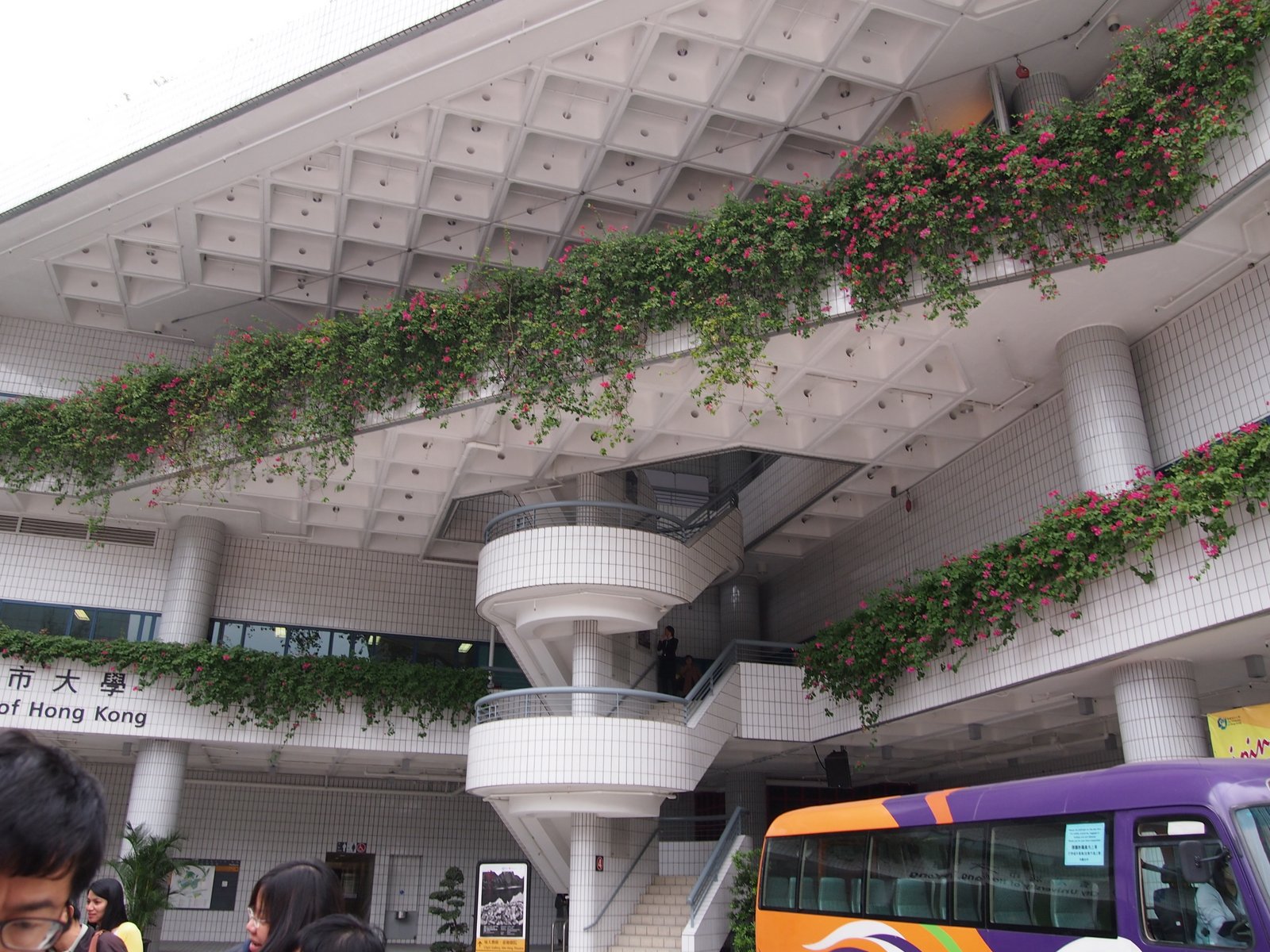
City U not only is connected to a mall, the university campus (can it be called so?) itself looks like a mall, with indoor concourses and escalators and stuff.
The tuition fee is very expensive, so the most students are from affluent families in mainland China. Most courses are monolingual in English.
The Christmas tree of the mall connected to the City U. Reminded me of SM in Manila.
I love all the road signs in Hong Kong. So clear and systematic. Not many cities in the world do a better job.
My usual stop in Tsim Sha Tsui when I don't have time to attend mass in the morning. They use the same missal as in the Philippines.
I forgot to bring my phone on this day, but saved by the free phone at Mariner's Club and the fact that I remembered the phone number of Alan, which has not changed since I first met him in my student days.
The Christmas decoration at Heritage 1881. Most people there were rich tourists from mainland China.
My usual postcard shot from Star Ferry Pier.
Sat on the wrong side of Star Ferry, on the way to Wanchai to meet up with Alan.
This is the classy mall in which we celebrated Alan's mother's birthday. But even in such posh places, you see some Sanrio characters. That's Hong Kong.
Late night, Alan and I stuffed ourselves at Fat Kei.
Very nice, but also quite expensive compared with Taiwan standards. Not many people would pay NT$200 for dessert alone except for tourists. But this wasn't a touristy place.