Showing posts with label World Englishes. Show all posts

Tuesday, October 3, 2017

Trinidad and Tobago going rhotic?


This video provides a rare opportunity to hear Trinidad and Tobago's TV ads.

You can here it in the background.

Instead of a typical Caribbean accent, you hear something similar to a standard Singapore accent.

Both Singaporean and Trinidadian Englishes are influenced by the presence of a large Indian community, so that's to be expected.

What's interesting is that there is also a commercial that has a rhotic accent in, presumably, an attempt to sound American.

Again, the situation seems similar to those of Singapore and Malaysia.


Saturday, August 26, 2017

Malaysians becoming rhotic

It's been ages since I last updated my blog.

I've decided to update it since both my parents and my brother are updating their blogs regularly.

So here's my post today. I've been noticing more and more younger generation Singaporeans, Malaysians and Hongkongers are starting to sound rhotic.

People say it's the influence of American media, but I don't buy it. Back then when I was there, all those places had lots of American programs on TV, but nobody was sounding rhotic.

I suspect one factor is the presence of Filipino domestic helpers in their households. But I noticed that  Hong Kong specialists are not very willing to admit the Philippine influence. But if you are brought up by a Filipina since young, it's inevitable that you end up having a rhotic accent, even if your local English teacher at school is non-rhotic.

So, anyway, I was talking to a Malaysian today, and noticed something interesting.

Malaysians who use English at home and in their social lives all the time since young, many of whom are Chinese and Indians, tend to be more non-rhotic. They sound very similar to Singaporeans to me.

But those Malaysians who speak from non-English speaking backgrounds (Bornean ethnic groups, Chinese-educated Chinese, etc.) who learn English later on in their lives as a foreign language, tend to have more American-like accents and therefore more rhotic.

A similar thing can perhaps be said about Hong Kong. When I went to a university in Hong Kong several years ago to attend a conference, many students proficient in English are mainlanders, and they had American-oriented accents.

In Singapore, socially-upward people, especially females, tend to be more rhotic. (I read an academic article before that said a rhotic accent is considered to be the proper pronunciation in Singapore despite the fact that Standard Singapore English is supposed to be RP-based.)

I wonder if this spread of rhoticity and formerly non-rhotic Southeast Asia is somehow related to the worldwide spread of Philippine English!

Wednesday, April 30, 2014

Is there still any point in teaching RP?

Some years back, I was attending a conference in Taiwan, listening to a senior Taiwanese scholar present on the Received Pronunciation (RP). It is roughly the same as "BBC accent" or "posh Southeastern English accent". The presenter said only 1% of the British population spoke with such accent. And yet he recommended it be taught to learners in Taiwan. So, during the Q&A session, I asked: If there are so few people using it, why should we teach it? Then my boss sitting next to me covertly reminded me that it was impolite to ask questions to senior presenters during Q&A sessions, so I backed off.

And to answer this question now myself, I think there is still a value in exposing learners to the RP, even though it's a dying (?) accent in England.

Even though RP has long lost its prestige in England, it is still widely taught to "foreigners", especially in Europe. So you are likely to come across a second-language speaker of English with an RP-inspired accent. In Hong Kong, Singapore, India and other Anglophone countries in Asia (with the exception of the Philippines), the teaching model at schools still derive from the RP. But many Taiwanese learners, especially those at lower proficiency levels, are quite unfamiliar with anything other than the idealized General American pronunciation. So they find it rather hard to understand second-language speakers who have learned British English back in their home countries.

Despite the fact that its speakers are considered "affected" and "cold" within the UK itself, the RP is a well-documented accent. There are many dictionaries and ESL textbooks that use this pronunciation, including authoritative ones like Daniel Jones's English Pronouncing Dictionary. Those are handy for teachers when they are not sure about pronunciation. On the other hand, most American dictionaries don't prescribe any one particular pronunciation. The phonetic symbols they use are designed to allow room for variation. Although language is and always will be varied (and that's the beauty of it), but that's not necessarily a comfortable situation for teachers looking for something "definitive". (Especially so for "non-native" teachers, who feel insecure for their perceived lack the authoritativeness as an authentic source of English.)

Plus, the RP has retained its prestige, in out of all places, America. I've seen many TV programs, commercials and movies where (fake) posh British accent is used for some supposedly positive effect. Even though very few people in Britain actually speak like that, Americans seem to associate it with some kind of fancy/fanciful European stuff. So if you are thinking of going to America, having an RP sort of accent might help. I must add though, that this might not apply if you are not European. My experience is that some Americans are not as favorable to non-whites with a British-derived accent. Maybe they notice you look like a foreigner and have an "unusual" accent, so they just conclude that you have a "foreign" accent. (Across the border in Canada, though, I notice that some people expect "foreigners" to be taught British English, even if their own variety is so much closer to that of the US.)

But in the context of Taiwan, all I'm saying is we should expose learners more to different accents including the RP, which is quite useful because it's taught to international learners. I'm not saying that they should all try to sound like the Queen with an exaggerated "aristocratic" intonation. Don't do this all the more if you are going to the UK. There, people with regional working class or black accents are considered cool nowadays. I'm saying that you will find it becomes easier for you to understand people from many different countries speaking English, once you are familiar with what they are being taught at school: the RP.

Wednesday, January 29, 2014

Resisting the "accentism" in Taiwan

This post is about accentism in English in Taiwan. There is a whole lot of issues regarding the accentism in Mandarin/Hokkien in Taiwan. Hopefully, I'll get to write about it one day!

In this post I will discuss briefly the following three issues: whether we should be teaching students what is considered in the society to be a "less than ideal" accent; why local accents are always belittled; how accentism is related to racism.

I have argued that students should be equipped to communicate with people from all over the world, particularly Asia, and not only with the native speakers of English. As I have been telling you, this means de-emphasizing nativelikeness in pronunciation teaching, as native-speaker accents are not suited for lingua franca communication. Some people have told me: "But, petekobe, don't you think we're shortchanging the students by not teaching them the most privileged accent, i.e. the native-speaker accents? If they go to a job interview in the future, they'll be disadvantaged if they had a weird accent."

My response is: No. We are not helping the society change its unfounded prejudices in accents by conforming to those prejudices. Let me use an analogy. You and I know that the mainstream society is biased against, say, black people. Would you advise a black student who is going to a job interview to paint his face white, so that he will stand a better chance of getting hired?

How the society privileges one accent and belittles others are based on how people associate certain accents with certain groups of people, and how they think about those groups. It has nothing to do with intrinsic linguistic qualities of any variety. It is absolutely untrue to say, therefore, that an American accent is superior than, say, Singapore accent, because the former is clearer, more accurate, more correct, etc. A Singaporean can do an excellent job communicating with another Singaporean in English, regardless of what an overhearing American thinks of their English. So, if someone thinks that a native-like north American accent is "class" and pleasant; and a very proficient and effective communicator with a trace of Korean or Chinese accent is unpleasant, less fluent, etc., it's to do with how you are socially conditioned. Prejudices are prejudices, and should be treated as such. There's no need to conform to it. It will not help students in the long run.

Now you may say: "Yeah, but it's the Taiwanese themselves who are looking down on their own accent." I agree. Just listen to those ads for language centers on ICRT. So many of them are about how shameful it is to speak Taiwan English, and how they can drop it by enrolling to those centers where they will be taught by "real 道地口音 native-speakers". The same problem seems to be prevalent even in nearby places where the local varieties of English are robustly functioning, like Hong Kong and the Philippines. Why do people look down on the accents of their own kinds?

The privileging of native-speaker accents and belittling of local accents reflect how people perceive the economic structure in the society. In order for you to have a nativelike, say, Canadian accent, either your parents have to be affluent enough to have sent you to Canada as a 小留學生 when you are eight years old, or at least be able to send you to a reputable buxiban. Certainly, if you were educated in the regular Taiwanese system, and you really tried hard in your English, you should sound like a regular Taiwanese person who can speak English well, but not like a "true native speaker". Because once past the "critical period", you have little chance of attaining a native speaker accent, if not other areas of linguistic competence.

So it is no wonder that the ELT industry (language centers, buxibans, etc.) has to propagate the idea that the only way to be successful in learning English is to master a native-like accent. And it is a good news for them that few people are likely to reach that goal, because they'll keep paying and paying the tuition in the hope that they will succeed one day! (The sad fact, though, is that many of them get discouraged and give up English altogether.)

On a final note, I want to talk a bit about how some people listen with their eyes and not with ears. Everybody has heard anecdotes along the line of a white Ukrainian getting hired as an English teacher, while a British native speaker of South Asian descent is turned away. I also heard that an Asian-British teacher with a posh RP-style accent always got complaints from students regarding his accent, while his white colleague with a strong northern England accent got none! One even gets an impression: If it is a white person speaking and learners find it hard to understand him, they'll blame themselves for their English not up to the standard; while if it's a non-老外 whom they're having trouble understanding, they'll blame it on the "weird" accent that their interlocutor has. Don't get me wrong. I'm not saying that a Ukrainian shouldn't be hired as an English teacher. More often than not, they are no less good English teachers than Canadians or South Africans. Their grammar and vocabulary may even be better than an average native speaker, and I have repeated many times that a native-speaker accent is not important. What I want to draw your attention to, however, is how arbitrary and baseless some judgments people make about accents are. Presuming that most employers in Taiwan have proclivity toward native speakers, this hiring person may not have noticed the "non-nativeness" of the Ukrainian because of what she looked like. And the very same person may well become very picky, if the candidate was a non-老外-looking person!

Monday, January 27, 2014

How to speak English as a Lingua Franca

More often that not, we so-called "non-native speakers" use English to communicate with other "non-native speakers". When a Japanese and a Taiwanese or a Korean and a Thai are conversing with each other in English at an international conference, English is being used as a lingua franca. In this case, there are some things you can do to facilitate successful communication. And those can be quite different from when you are trying to communicate with native speakers of English. So please try the following tips, unless you are intending to immigrate to an inner-circle country (a country where the majority of people are "native speakers" of English; e.g. U.S.A.) and blend in to the mainstream society there.

1. Speak slowly and clearly. Enunciate each and every syllable. Never contract or omit syllables. If you do this, you will sound more "foreign" or less non-native-like to native-speaker ears. But believe me, all other people will find it easier to understand you.

2. When in doubt, use "spelling pronunciation". When you come across words you're not sure how to pronounce, just read it out syllable by syllable, as if you are pronouncing an Italian or Indonesian word. For example, if you are not sure how to pronounce "Abimelech", just say "ah-bee-meh-leck". Surely, you will sound very non-native-like. Native speakers may even think that your "foreign" accent is really strong. But don't worry, native speakers are in minority of English speakers today. If you are using English as a Lingua Franca, what native speakers will think of your accent is quite irrelevant. And I guarantee you that all the non-native speakers present will understand you better!

3. Avoid using any idioms or slang as much as possible. Some Asian people like using idioms, thinking that it can show how native-like their English is. But those idioms can be obscure to your non-native listeners. One of the reasons why native speakers of English are hardest to understand in international conferences is that they use many idioms that are culture-specific. For example,  many American idioms originate from baseball terms, when most people in the world are completely ignorant about baseball. (Taiwan, South Korea and Japan are obvious exceptions.)

If you want to use an idiom for a specific effect, make sure you explain the meaning. In some cases, you may use translated versions of some idioms if you are sure that the same idiom is used in the country where your counterpart comes from. For example, "having an iron rice bowl" is understood in many Asian countries as meaning having a very stable job.

4. Try to use as easy words and expressions as possible. Make sentences short. Stick to "one idea per sentence" principle. Some Asian people like to use "big words" to show that their English is good. But this does not help communication at all if it makes the meaning more obscure.

5. Optionally, you can model your English after a second-language variety, such as Philippine English and Singapore English. Native-speaker varieties, for instance American English, have some disadvantages. First, formal empirical research found that native speakers are not the easiest to be understood in international communication situations. Some people think that just because American English is the "standard" English, so it should be universally understood; but this was proven not to be the case. Secondly, a native speaker accent is unattainable for many. If you are already past the "critical period", it is highly unlikely that you will ever sound like a "true native speaker", no matter how hard you try. So you have to settle permanently for a second-best: "trying to sound native, but not quite there yet".

6. Finally, this is anecdotal and has not been proven yet, although some informed experts do recommend it: Try to pronounce all the "r's" in the spelling if possible, like in an American accent. I have a very strong hunch that this will make you easier to be understood by many non-native speakers. What I mean is this: if you learned English in such places as Hong Kong, Malaysia and many other countries, you may have been taught British English. In the so-called standard British pronunciation, the "r" in the spelling is not always pronounced, as in such words as "car park" and "Peter". There is nothing wrong at all with this kind of pronunciation; I myself was taught this way in Japan. But since people in many Asian countries usually learn to read and write English before they can speak it, it makes more sense to them that when there is an "r" in the spelling, it should be pronounced. In Taiwan or South Korea, some people may even think that your English is poor if you fail to pronounce the rolled "r", because those countries are under so much American influence.

Again, all these tips are applicable only if you are using English to communicate successfully with other non-native speakers. If your purpose of learning English is to communicate exclusively with native speaker, though this is becoming quite rare, I suggest you try to get as close as possible to a native speaker accent. Even people with extremely high proficiency in English, for example former U.N. secretary-general Mr. Kofi Anan, are still considered by many native speakers to have a very strong accent and sometimes even ridiculed, just because they don't sound American or British. (You may say that it's not good to advice students to settle for something "less than ideal", because they may be disadvantaged in future job interviews, etc. I will address this in a separate post.

Friday, June 14, 2013

Non-rhoticity: A sign of failure?

Another interesting conversation I had, this time with Taiwanese linguists, at IAWE Hong Kong.

One of them said: "I noticed that you have a British accent." So he noticed my non-rhoticity and connected that with a British accent. This is not surprising; after all, he's a specialist.

"But many students in Taiwan don't make that connection," I said. "They just think that I'm a poor speaker of English, just because I don't roll my /r/ like their junior high school teachers did."

He said something very important. He said the pronunciation of rhotic /r/ is so emphasized in Taiwan's English teaching that non-rhoticity is considered a failure in an attempt to produce it!

Unless you are a Caucasian from the UK, South Africa, New Zealand, etc., that is. (People often listen with their eyes, more than they do with ears.)

Indeed, in a book called "KK音標速成秘笈", the author says:
中國學生(尤其是說閩南語的同學)發此音時,舌頭大都不夠捲,也不夠軟,而中國北方省份的居民,如北平人,發此音就發得很好。若想把美語說得「溜」就得每天花一點時間練習這個音 (p. 50)

On another page he also says:
每天練習國語的注音符號「ㄦ」的聲音,可使舌頭變得較靈活。另外準備一面小鏡子觀察自己發音時的嘴型。(p. 25)

So I did a little experiment in one of my classes. I played a recording of a very typically British RP-sounding speaker, and showed them a picture of a Japanese guy at the same time. Then I asked them what they thought about the accent.

They said "Horrible! This guy's got to do something about his strong Japanese accent!" or something similar!

By the way, the above author says in his book that when he was growing up as a child, his parents were speaking in a "foreign language". (Of course he can't say they were speaking in Japanese! He's an English teacher for goodness' sake!) That's probably why he was drilled by his Mandarin teachers to pronounce the "ㄦ" correctly. So he transferred that to English.

So then, this has got all to do with the "正音 Ideology", then. Well, that's another topic.

In the meantime, if I want to keep my job as an English teacher, I should better get in front of a mirror and start going: "rr, rrr, rrrrrrrrrrrrrrrrrrr!"

Rhoticity in Hong Kong English: A Philippine influence?

I've wanted to write about this for a long time, but never found the time to do so.

I found this study about rhoticity in Singapore English (http://www.icphs2011.hk/resources/OnlineProceedings/RegularSession/Tan/Tan.pdf). In a nutshell, it found that many people in Singapore consider rhoticity (pronouncing the /r/ in words like "car" and "cart") to be a sign of good education and higher social status.

I was wondering about this for a long time. When I was living surrounded by Singaporeans about 20 years ago, none of them had a rhotic accent. Then I came across some very fashionable Malaysian students who tried to sound rhotic, seemingly in an attempt to appear "Americanized" and "cool". And recently, I started listening to Singaporean talk shows on internet radio, and noticed that more and more seemingly "upwardly mobile" people, especially female, are starting to "roll the r".

This is interesting because, from what I know, in southern England, having a rhotic accent is considered a sign of being a country bumpkin rather than hip and cool. (You sound like you are from Ireland or West Country or somewhere like that if you pronounce the "r". Even people in Lancashire don't do that anymore, you know!) So this is another sign of increasing dominance of American English even in traditionally British-oriented outer-circle Asia (minus the Philippines, of course).

Now, when I attended the IAWE conference in Hong Kong last year, there was a linguist from Hong Kong saying that some younger Hong Kong speakers are going rhotic due to the influence of the American media inputs. This is hardly surprising because many of the DJs and personalities on English channels of RTHK have north American accents. And if I'm not mistaken, among the expat communities in Hong Kong today, there are more Americans and Canadians than Brits.

I asked him if this could also be because many Hong Kong families hire Filipino helpers to take care of their children. In fact, quite often, those helpers are the only people with whom many Hong Kong children converse in English, so it would not be a surprise if Hong Kong youngsters picked up the Philippine rhotic /r/ from them, even if they are still taught the non-rhotic RP at school. But the linguist in question categorically denied this possibility. I was not quite convinced. Maybe some research is needed.

Friday, February 1, 2013

Trilingual medical personnel in Taiwan

Medical personnel in Taiwan are at least trilingual. At the physical theapy room in a hospital where I visit twice a week, the language I hear most often is Taiwanese Hokkien. This is because most of the patients are elderly. The therapists communicate with them in Hokkien, of course, but I can tell that many of the young therapists are not very fluent in it. They must have grown up speaking almost exclusively Mandarin like other young people in Taiwan, and received special training in Hokkien to deal with Hokkien-monolingual patients. When they converse with other therapists regarding something they don't want their patients to overhear, for example someone's medical condition, they switch to English (Another instance of the boundary between the Outer and Expanding Circles being blurred). This is normal because medical training in Taiwan heavily use English. Aside from this, many doctors and nurses can speak Japanese as well.  I also know of some Filipino doctors practicing in Taiwan who are multilingual in this way. (They can speak Mandarin, Taiwanese-style Hokkien, as well as English, Filipino, Philippine-style Hokkien and perhaps even one more Philippine language!) I also know of a second-generation mainlander who had aspired to become a doctor in Taiwan, but gave up because of her failure to master Hokkien. It's difficult being a doctor in Taiwan and unable to speak Hokkien, because many patients are elderly.

Wednesday, December 26, 2012

SYSU and me: IAWE conference in Hong Kong and Guangzhou (Day 4-1)


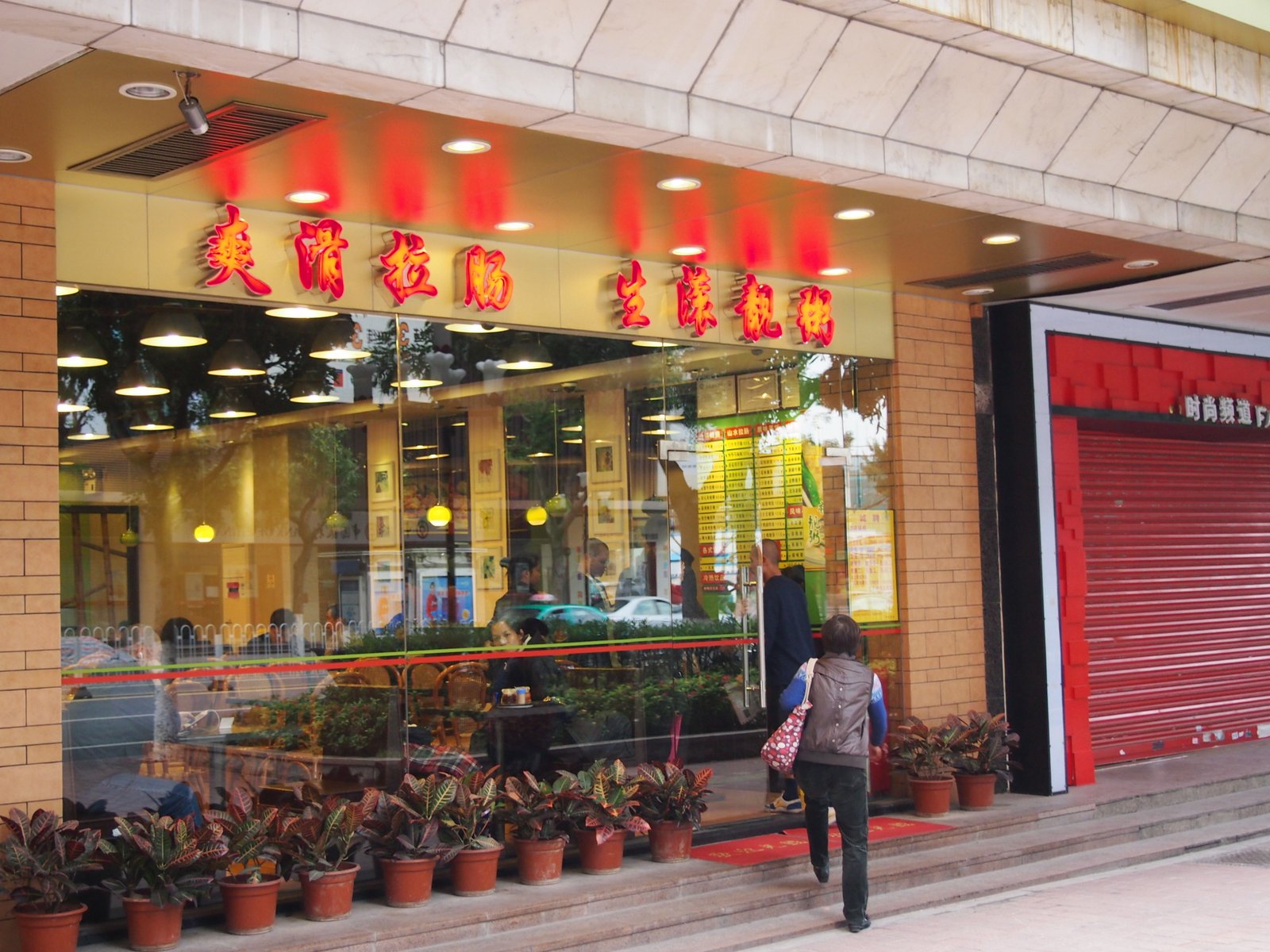
Zhousan! A colleague from Guangzhou, whom I met when I was working part-time at a Chinese restaurant when I was in high school in Tokyo, once told me, the congee in Guangzhou is "number one". I remembered what he said.

Well, although I'm sure that century egg and lean meat congee of this quality can be found easily in Hong Kong, and in Taipei if you look hard enough, but any random shop nearest to hotel can offer this quality is a sign that the level in Guangzhou is quite high!
 

Bought coffee at a bakery, and walked toward Sun Yat-sen University, venue of the conference. I spotted many foreigners.
 

Here I am at SYSU at last. There's a long story about SYSU and me. To tell you the truth, I once had a dream of studying there. It was the first Chinese university that I had heard of.

When I was in junior high, I became so obsessed with China that I started attending Chinese mass at Sophia University, hoping to learn some Chinese for free. There, I met Fr. Cochini, a French jesuit who spoke excellent Mandarin Chinese. He told me that he had taught French at SYSU in Guangzhou. That's how I first heard of the place.

Later, I became more interested in Cantonese than Mandarin. Back then in Japan, the easiest way to get in touch with Chinese culture was to watch hugely popular Hong Kong movies, of which I was a big fan. Those were all in Cantonese soundtrack with Japanese subtitles. Many of my classmates knew some Cantonese phrases from watching them. On the other hand, the only chance to hear Mandarin was NHK's Chinese courses. The strong Beijing-style rolled tongues and communist-style culture that went along with them put me off. (I somehow had an impression that most people who were learning Mandarin in Japan were left-wing people.)

So I started having a dream of going somewhere where I could learn Cantonese and Mandarin at the same time, and SYSU was such a place. (Back then, the idea of learning Mandarin in Hong Kong seemed a very bizarre one, even more so than learning English there.)

The first time I actively sought possibility of studying Chinese was when I was in the second year of university in the UK. In the UK back then, Chinese meant Cantonese. I looked into possibility of going to SYSU in Guangzhou. After all, I had an uncle who had studied at the Institute of Chinese medicine in Guangzhou, so it did not seem to be an outladish idea. However, I learned that foreigners had to pay a special rate in mainland China, and that the living conditions in dormitories in China were still not suitable for foreigners. Eventually, my friends from Hong Kong recommended going to Taiwan instead. Eventually, that's how I ended up in Taiwan.

I learned for the first time from Prof. Bolton that SYSU used to be the Christian College of Canton run by American missionaries. Interesting for me because my paper was about missionary schools teaching English in Taiwan.
 

Coffee shop. I really liked the building styles of SYSU, which were a combination of southern Chinese and western elements.
 

Signs in traditional characters. I thought the government had banned the use of the traditional in public signs...

Personally, I used to prefer simplified because it gave me less pain writing. But now that most writing are done by typing on computers, it makes no difference. Besides, the traditional seems to be aesthetically more pleasing.

High school field trip?


I liked those buildings.
 

I was surprised this one not taken down during the recent anti-Japanese riot.
 

Language classrooms were modern and cozy.
 

Lunchbox provided by the conference was very nice. Not very cheap, it seemed. I liked it much better than western style conference food in Hong Kong. I like western too, but I don't have to eat it in Hong Kong and China.
 

Zhongda Yixian mineral water!
 

Mandarin orange from southern Fujian, provided together with lunch. The culture is different from Hong Kong, even though it is so close geographically.
 

The signs are very clear and well-designed. It's good they spelt it "Yat-sen Road", instead of "Yixian Road"!
 

The school of Foreign Languages. Finally, I arrived at the venue of the conference. Pretty much the whole day was spent in the conference, which included the presentation of my own paper.

It was cool to listen to David Graddol in such a close distance, and his talk on languages in the Pearl River Delta was immensely interesting!

In the next post, I'll write about my "adventure" to the Sacred Heart Cathedral in Guangzhou, with the "remote control" from Wendy, a student at SYSU.

To be continued...
 
Posted by Picasa

Wednesday, December 19, 2012

Back to China again; IAWE conference in Hong Kong and Guangzhou (Day 3-2)

First of all, I would like to thank the kindness of all my friends in/from China. Without their help, this "fun" trip would not have been possible!
Nice to be back in China! This is the China side of Shenzhen Bay immigration. The procedure was efficient and speeedy, and the immigration officer actually smiled at me!

It's always nice to be back in the familiar world of Mandarin in Shenzhen, coming from the strange Cantonese environment of Hong Kong. Shenzhen is a predominantly Mandarin-speaking city, despite its location in Guangdong and proximity to Hong Kong. I'll write a separate article about the language situation in Pearl River Delta later.

Another reason why I feel a sense of relief being back in China may have to do with the orderlyness or otherwise. Hong Kong is very much like Japan, where everything is squeeky clean, orderly and done according to the rules. While it's nice, it may give somewhat suffocating feeling to someone who has lived in Taiwan for so long! I always feel relieved when I arrive in "chaotic" Taipei after being in Japan for a while. Entering China from Hong Kong, or going to Johor Baru from Singapore for that matter, gives me a similar feeling. 
Our nice coach belongs to Hong Kong side, judging from the side of the steering wheel.
Everything in Shenzhen is new and shiny. I like old cities, but SZ is interesting in its own way, because it is unlike any other city in China. This time, though, we had to bypassed it.
When we passed by Dongguan, which is known as "Little Taiwan", I tried to look for any traces of Taiwan from the window of our coach, but could not find any, except the fake Mickey on a kindergarten wall.
Guangzhou, here we come!

Gangnam style in Guangzhou. Before this, they were dancing to salsa and Hindipop tunes! Globalization...

A huge mass of people dancing in the park really reminded me that I was in China! Thanks, Wendy and Xiao-wan, for taking me around.
Thanks to Wendy and Xiao-wan, I finally arrived at Sun Yat-sen University, my destination. Rather different from my expectation... I mean, I didn't expect hundreds of people dancing Gangnam style in front of its gate.

It would be nice to take a cruise on Pearl River.
Yes, this is the kind of Guangzhou thing that I wanted to experience. A restaurant row near the Small North Gate of SYSU. I would not have been able to find it without Wendy and Xiao-wan taking me there.
Luckily, it was not as spicy as it looked. Perhaps Xiao-wan wanted it spicier! She's from Vietnam.
Teppan-tofu. I didn't realize it was a Cantonese dish.
Of course, we got to eat a lot of fresh veggie.
The streets in the area where I stayed was not glossy like Shangri-La area, but were wide, clean, and bright. The roads were evener and tidier in general than Taipei. Maybe thanks to the clean-up before the Asian Games?

It's amazing to witness how fast big cities in China advance. When I first went to Shanghai in 1997, Pudong, which is now full of futuristic skyscrapers, was just a pile of mud. There was no linear motor car from the airport then, so I had to be careful not to be ripped off by tricycle drivers (but I still was). People could tell me immediately that I was from overseas from the way I dressed. Quite a few men were still wearing Mao jacket back then. Some toilets were starting to have doors, but it still did not occur to some people that they could close them.

Of course, I'm happy about the development of China. But I somehow also miss the days when visiting China was such an adventure. Really, not one day passed without an incident which really blew my mind. Both good and bad, but maybe more bad.
Thanks to the recommendation by Amy, one of the exchange students from China in my class, I chose to stay at 7-days Inn. One of the reason why this hotel chain can keep the prices so low is because they choose locations that are hard to find. But it does not mean that they are in inconvenient locations. There was this Family Mart near my hotel, which reminded me of Taiwan. (On the other hand, Seven-Elevens and Circle Ks in Guangzhou are more like those in Hong Kong.)

At this Family Mart, I often spotted many foreigners, who appreared to be from Africa and Russia. The guy in the shop spoke very good English. But he spoke to me in Cantonese.

It seems that Cantonese is the first choice for convenience stores in Guangzhou. Perhaps because it gives a Hong Kong kind of feeling? (Read my post on the robustness of Cantonese.) 
This room for RMB157! Well worth it. Such a far cry from the disgusting room in Hong Kong which was for HK$280 per night! (It eventually became HK$480 per night because they charged Alan HK$200 for the no-show the first night...)

Because otherwise, I found the prices of things quite expensive in Guangzhou. I felt the food in restaurants and other things in the convenience stores much more expensive than in Taipei. Later, I learned that properties in Guangzhou can actually be more expensive than those in Taipei. So the price at 7-days Inn is even more surprising. 
Facilities were very clean. There was abundance of hot water for shower. (This can be a problem for cheap hotels in many countries.)
Internet was OK, except that Gmail and Facebook were slow (due to the Great Firewall?).

Hot water for making tea is a must for Chinese travellers anywhere.
Towels were very clean and changed everyday.

As usual for hotels in China, there was a price list of equipments in the room for those who wanted to take them home for souvenirs. It included, as usual, prices for things like toilet lid and the map for emergency evacuation.

I was able to sleep well that night.

Friday, December 14, 2012

Before departure to China: IAWE conference in Hong Kong and Guangzhou (Day 3-1)


I woke up early in the morning to take a stroll in the public park behind Alan's house. I think the Brits did a good job in planting trees all over Hong Kong. Across the border in China, many hills are just bare rocks. Those in Hong Kong must have been the same, since they share the same climate, and they are just a few kilometers away from each other. The vegetation can't be that radically different.

The park has Chinese herb gardens and walking trails with Chinese qigong and 養生 theme. It is very tastefully done, and far better than fake Euro-Japanese style often seen in Taiwan. 

Hong Kong style, early morning. I saw some old Indian ladies practicing taiji. The old taiji master spoke English. He must have taught many non-Chinese Hong Kong residents.

This is the building in which Alan's flat is.

Don't know which flat, though...

At the top of the hill in the park, there is this pavillion. I did my morning prayer there.

Down the hill towards Chinese herbal garden.

Despite the fact that the important highway connecting the international airport with the city center was right behind the park, it was very quiet there. It was a very nice park, and I think the government of Hong Kong is doing a very good job designing and maintaining public spaces. I wish Hakone-yama in Shin-okubo was as nice as this one...
 

After a healthy morning stroll, unhealthy breakfast. At a tea house underneath Alan's flat.

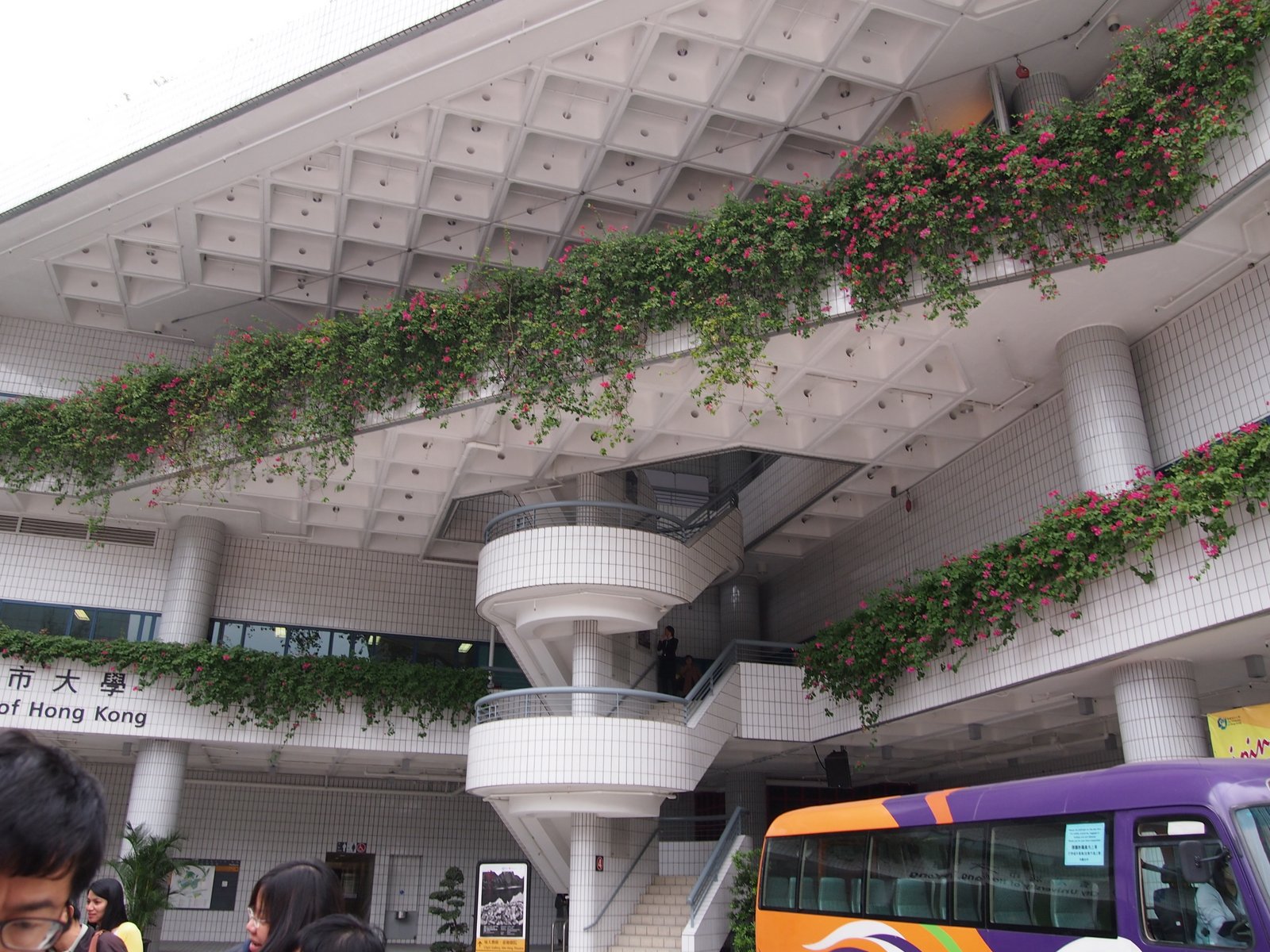
That tutorial center famous in Manila was also here. Not a single Chinese word written in all of the tutorial centers I found in Alan's flat, reminding of English-medium education in Hong Kong. They spelt "math" the Philippine way! (It should be "maths" in the Hong Kong style.) Could many tutors be from the Philippines, as in many other countries?

Despite the fact that teaching model in Hong Kong schools is still the RP, I noticed that more and more children there are sounding rhotic. Could this be Philippine influence? Although the Hong Kong presenter I met at the conference denied the possibility and attributed it to American influence through the media, it is still true that those kids in Hong Kong get most exposure to English through their Philippine yayas.
 

Every year, the same lunch at the City U! I skipped the western style lunch provided at the conference and went to Festival Walk to eat this. I feel that the price of food in Hong Kong to be about the same level as Tokyo.

At the back gate of the City U, awaiting coach to China. Coaches in Hong Kong and China looked much more trustworthy than those we see here on Taipei roads, at least on the surface. No amateurish paintings of fake Donald Duck and Doraemon next to a Chinese fortune god, nor unpronouncable Chinese transliterations, different on the both sides despite the same Chinese name, on the body.

Now, off to China! Professor Moody of Universidade de Macau explaing the immigration requirements. People were wondering why on earth only the Japanese and Singaporean passport holders were not required a visa, when even those Macau residents holding US/European passports needed one. I felt the strong link between Japan and the People's Republic, despite all the recent fuss.
Posted by Picasa