Showing posts with label Conferences. Show all posts

Wednesday, November 17, 2021

What LPP can teach us about BN30

I recently attended a conference here in Taipei where many discussions were over the Bilingual Nation 2030 (BN30) policy of Taiwan. Prior to attending the conference, I happened to have re-read books about Language Policy and Planning (LPP). This was helpful for coming up with some personal observations about the policy. Here are the three takeaways from the conference, informed by findings in LPP studies.  

Number one: Two languages can never coexist stably in the same domain in the same society. Therefore, trying to teach content knowledge in two languages at the same time may end up to be a futile effort unless done very skillfully. The only way for multiple languages to coexist in one society is for those languages to be used in different domains. Within the context of elementary and secondary education in Taiwan, it seems that the main vehicle for conveying content knowledge will be Mandarin; while English will be used for classroom interactions. 

Number two: It is very difficult to make people change their linguistic behavior, unless using very coercive means. Actually, Taiwan already is a very rare example of success. Under the high-handed one-party rule by the KMT, Mandarin successfully supplanted Hokkien (a.k.a Taiwanese), Japanese, and other indigenous languages in Taiwan because there was a large-scale stigmatization campaign of the latter by the government. As the democratization advanced, millions of dollars and massive effort went into revitalizing Hokkien, Hakka and aboriginal languages, but the attrition of those languages has been unstoppable. On the other hand, people tend to voluntarily shift towards the language with higher prestige that promises economic gain and ability to communicate with the larger society. This is why many Hakkas abandoned their language in favor of Hokkien, and later, Mandarin. What the KMT government succeeded in doing was artificially creating a situation where Mandarin became the prestige language. So, if English proves to be a language with real prestige and utility, people will jump at it without any coercion. (This may especially be the case, after hearing in the conference of a finding that very small percentage of Taiwanese people were worried that adopting English would threaten their cultural identity.)

Number three: Immersion approach may work best in changing the linguistic behavior of the next generation. In direct contradiction to the mainstream voice in the profession which claims using the learner's L1 to scaffold their L2 learning is the most efficient method, L2-only immersion programs are known to produce good results, where children acquired high proficiency in L2 while maintaining L1. However, it must be noted that many of these immersion success stories originate from locations where children get a lot of exposure to both languages outside classroom. It also presupposes that there is a sufficient number of teachers highly proficient in L2. 

Based on the above points, here are some observations about the prospects of BN30. If the goal of the policy is to shift the medium of instruction (MoI) from Mandarin to English, the chance of success does not seem very high under the current approach. (Indeed, the policy statement of the Taiwanese government states that one of the main goals of the policy is to increase the number of students who are capable to attending English as a medium of instruction (EMI) courses in universities.) It  may succeed, though, in replacing Mandarin with English as the language of classroom interaction between teachers and students, while the medium for imparting content knowledge remains Mandarin. This will create a situation hitherto non-existent in Taiwan, namely, English being used as a language for domestic communication, albeit in limited domains. It may have an indirect effect of creating a generation more predisposed to learning English further, so as to enter EMI programs in higher education. In any case, it is essential for the government to clarify the goals of BN30 in more concrete terms, and adopt measures that are more finely tuned to accomplish them. 

Wednesday, April 30, 2014

Is there still any point in teaching RP?

Some years back, I was attending a conference in Taiwan, listening to a senior Taiwanese scholar present on the Received Pronunciation (RP). It is roughly the same as "BBC accent" or "posh Southeastern English accent". The presenter said only 1% of the British population spoke with such accent. And yet he recommended it be taught to learners in Taiwan. So, during the Q&A session, I asked: If there are so few people using it, why should we teach it? Then my boss sitting next to me covertly reminded me that it was impolite to ask questions to senior presenters during Q&A sessions, so I backed off.

And to answer this question now myself, I think there is still a value in exposing learners to the RP, even though it's a dying (?) accent in England.

Even though RP has long lost its prestige in England, it is still widely taught to "foreigners", especially in Europe. So you are likely to come across a second-language speaker of English with an RP-inspired accent. In Hong Kong, Singapore, India and other Anglophone countries in Asia (with the exception of the Philippines), the teaching model at schools still derive from the RP. But many Taiwanese learners, especially those at lower proficiency levels, are quite unfamiliar with anything other than the idealized General American pronunciation. So they find it rather hard to understand second-language speakers who have learned British English back in their home countries.

Despite the fact that its speakers are considered "affected" and "cold" within the UK itself, the RP is a well-documented accent. There are many dictionaries and ESL textbooks that use this pronunciation, including authoritative ones like Daniel Jones's English Pronouncing Dictionary. Those are handy for teachers when they are not sure about pronunciation. On the other hand, most American dictionaries don't prescribe any one particular pronunciation. The phonetic symbols they use are designed to allow room for variation. Although language is and always will be varied (and that's the beauty of it), but that's not necessarily a comfortable situation for teachers looking for something "definitive". (Especially so for "non-native" teachers, who feel insecure for their perceived lack the authoritativeness as an authentic source of English.)

Plus, the RP has retained its prestige, in out of all places, America. I've seen many TV programs, commercials and movies where (fake) posh British accent is used for some supposedly positive effect. Even though very few people in Britain actually speak like that, Americans seem to associate it with some kind of fancy/fanciful European stuff. So if you are thinking of going to America, having an RP sort of accent might help. I must add though, that this might not apply if you are not European. My experience is that some Americans are not as favorable to non-whites with a British-derived accent. Maybe they notice you look like a foreigner and have an "unusual" accent, so they just conclude that you have a "foreign" accent. (Across the border in Canada, though, I notice that some people expect "foreigners" to be taught British English, even if their own variety is so much closer to that of the US.)

But in the context of Taiwan, all I'm saying is we should expose learners more to different accents including the RP, which is quite useful because it's taught to international learners. I'm not saying that they should all try to sound like the Queen with an exaggerated "aristocratic" intonation. Don't do this all the more if you are going to the UK. There, people with regional working class or black accents are considered cool nowadays. I'm saying that you will find it becomes easier for you to understand people from many different countries speaking English, once you are familiar with what they are being taught at school: the RP.

Friday, June 14, 2013

Non-rhoticity: A sign of failure?

Another interesting conversation I had, this time with Taiwanese linguists, at IAWE Hong Kong.

One of them said: "I noticed that you have a British accent." So he noticed my non-rhoticity and connected that with a British accent. This is not surprising; after all, he's a specialist.

"But many students in Taiwan don't make that connection," I said. "They just think that I'm a poor speaker of English, just because I don't roll my /r/ like their junior high school teachers did."

He said something very important. He said the pronunciation of rhotic /r/ is so emphasized in Taiwan's English teaching that non-rhoticity is considered a failure in an attempt to produce it!

Unless you are a Caucasian from the UK, South Africa, New Zealand, etc., that is. (People often listen with their eyes, more than they do with ears.)

Indeed, in a book called "KK音標速成秘笈", the author says:
中國學生(尤其是說閩南語的同學)發此音時,舌頭大都不夠捲,也不夠軟,而中國北方省份的居民,如北平人,發此音就發得很好。若想把美語說得「溜」就得每天花一點時間練習這個音 (p. 50)

On another page he also says:
每天練習國語的注音符號「ㄦ」的聲音,可使舌頭變得較靈活。另外準備一面小鏡子觀察自己發音時的嘴型。(p. 25)

So I did a little experiment in one of my classes. I played a recording of a very typically British RP-sounding speaker, and showed them a picture of a Japanese guy at the same time. Then I asked them what they thought about the accent.

They said "Horrible! This guy's got to do something about his strong Japanese accent!" or something similar!

By the way, the above author says in his book that when he was growing up as a child, his parents were speaking in a "foreign language". (Of course he can't say they were speaking in Japanese! He's an English teacher for goodness' sake!) That's probably why he was drilled by his Mandarin teachers to pronounce the "ㄦ" correctly. So he transferred that to English.

So then, this has got all to do with the "正音 Ideology", then. Well, that's another topic.

In the meantime, if I want to keep my job as an English teacher, I should better get in front of a mirror and start going: "rr, rrr, rrrrrrrrrrrrrrrrrrr!"

Rhoticity in Hong Kong English: A Philippine influence?

I've wanted to write about this for a long time, but never found the time to do so.

I found this study about rhoticity in Singapore English (http://www.icphs2011.hk/resources/OnlineProceedings/RegularSession/Tan/Tan.pdf). In a nutshell, it found that many people in Singapore consider rhoticity (pronouncing the /r/ in words like "car" and "cart") to be a sign of good education and higher social status.

I was wondering about this for a long time. When I was living surrounded by Singaporeans about 20 years ago, none of them had a rhotic accent. Then I came across some very fashionable Malaysian students who tried to sound rhotic, seemingly in an attempt to appear "Americanized" and "cool". And recently, I started listening to Singaporean talk shows on internet radio, and noticed that more and more seemingly "upwardly mobile" people, especially female, are starting to "roll the r".

This is interesting because, from what I know, in southern England, having a rhotic accent is considered a sign of being a country bumpkin rather than hip and cool. (You sound like you are from Ireland or West Country or somewhere like that if you pronounce the "r". Even people in Lancashire don't do that anymore, you know!) So this is another sign of increasing dominance of American English even in traditionally British-oriented outer-circle Asia (minus the Philippines, of course).

Now, when I attended the IAWE conference in Hong Kong last year, there was a linguist from Hong Kong saying that some younger Hong Kong speakers are going rhotic due to the influence of the American media inputs. This is hardly surprising because many of the DJs and personalities on English channels of RTHK have north American accents. And if I'm not mistaken, among the expat communities in Hong Kong today, there are more Americans and Canadians than Brits.

I asked him if this could also be because many Hong Kong families hire Filipino helpers to take care of their children. In fact, quite often, those helpers are the only people with whom many Hong Kong children converse in English, so it would not be a surprise if Hong Kong youngsters picked up the Philippine rhotic /r/ from them, even if they are still taught the non-rhotic RP at school. But the linguist in question categorically denied this possibility. I was not quite convinced. Maybe some research is needed.

Friday, February 22, 2013

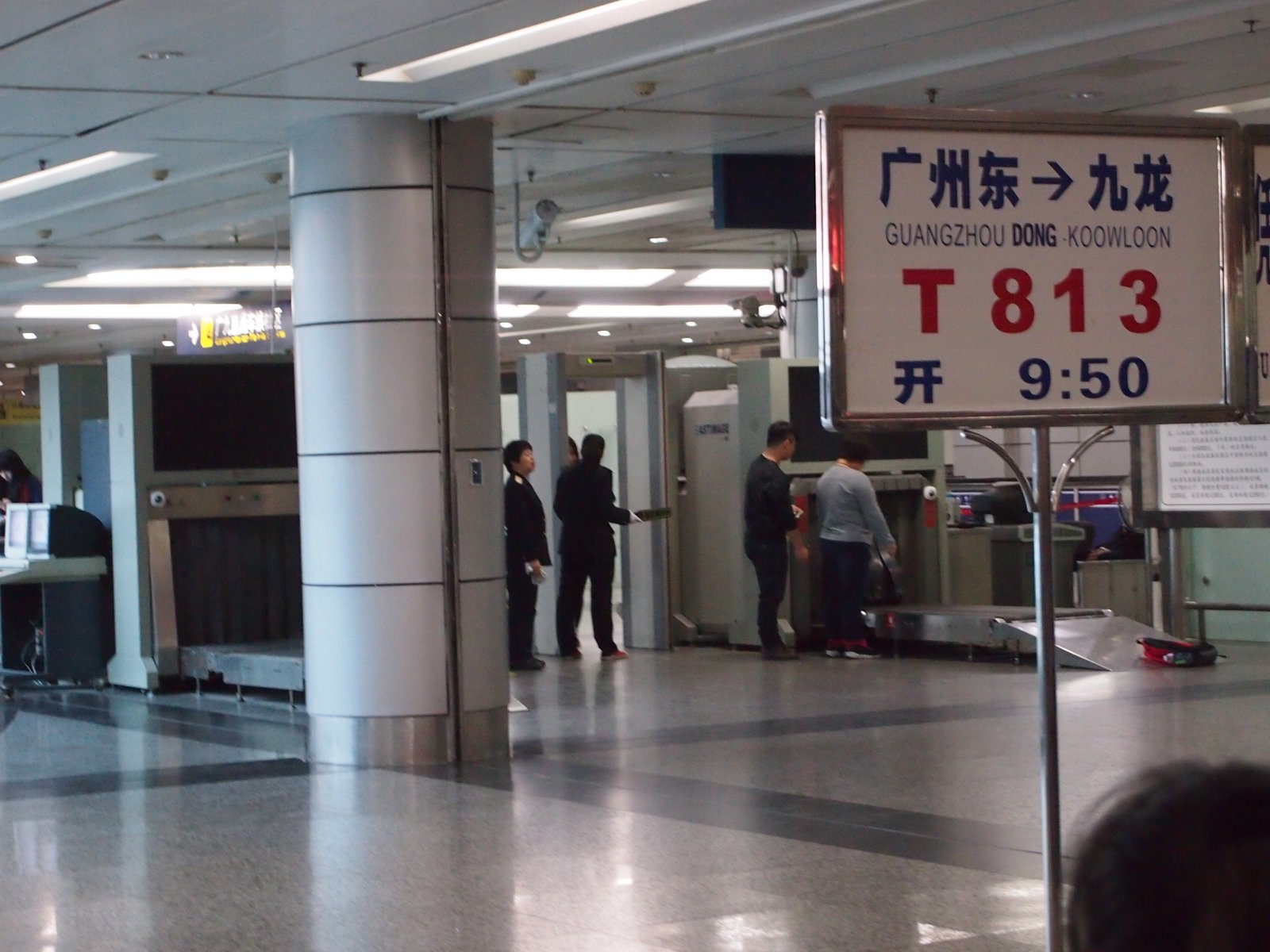
Train ride from GZ to HK: IAWE conference in Hong Kong and Guangzhou (Day 5-1)


It's been such a long time since I last took a train in China. Looking forward to the trip!
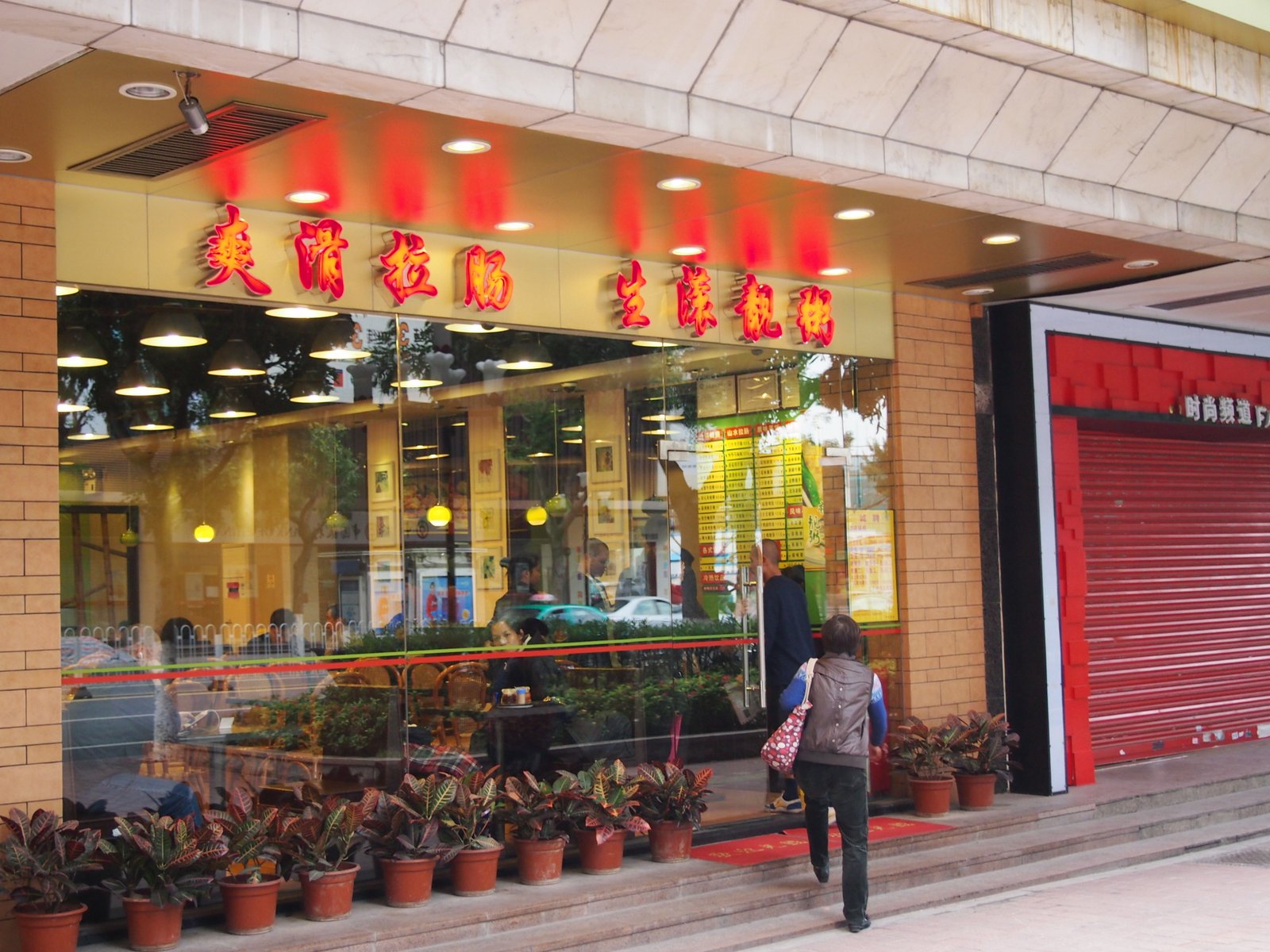
Fast food restaurant in Guangzhou train station was Chinese style with Bruce Lee on the sign.


The "international" train to Hong Kong leaves from upstairs. Saw many adverts for "男科醫院" here...

Never heard of 男科 in other countries...!


Waiting for the immigration gate to open. Come to think of it, this is my first time crossing a boarder on a train.


There are two kinds of trains between Guangzhou and Hong Kong. The China ones and Hong Kong ones.

Of course, I chose the China one!

Hong Kong trains use made-in-Japan carriages and it would be the same as any other ordinary train ride experiences.


I'm glad that the Soviet style uniforms are still alive!

I hope they won't "modernize" those communist-style uniforms because they are one of the tourist attractions for foreigners.

Although it's also true that British-style uniforms in Hong Kong do look good!


"Ruanzuoche"


Very comfortable.

I love the color of seats and the design of the carpet!

It would just be the same as any train anywhere in the world without those Chinese characteristics.


No more conductors distributing hot water with a big kettle! (Sayang!)

It would have been more environmentally friendly than distributing bottled water, which many passengers don't drink anyway.

In China, people USED TO bring their own cups. In other countries, people are JUST STARTING to do so for environmental concerns.

By the way, I was told off by this conductor for taking pictures in the train!


A much more modern and faster train that connects Guangzhou with Shenzhen.


Guangdong must be one of the best part of China. Clean and green!

Such a stark difference from typically arid and dusty landscape of the rest of mainland China!


Arrived in Shenzhen.

This ultra-modern city used to be a sleepy farming village until Deng Xiaoping came here in the early 80s.


Crossing the boarder! On the right is the China side.


The ultra-modern city landscape of China turns into a squeeky clean natural-park style countryside once the train enters Hong Kong.

In my opinion, one of the best legacy of the British rule in Hong Kong is the separation of commercial/residential areas with natural reserves.

If this was in Taiwan (or in mainland China for that matter), those green hills would already be teeming with fake-European-style residential towers, hot spring resorts, night markets and graveyards.


Arrived at Kowloon station (Hung Hom).

I realy like the traditional Chinese fonts used for signs in Hong Kong MTR. They are traditional, yet modern.


Hung Hom station looks like one of the more modern train stations in Europe. Big glass windows and metal roofs are really unsuitable for tropical weather and wastes a lot of electrcity for airconditioning.

 But I think the European aesthetics are still very much alive in Hong Kong. And they have enough money to afford to look good, I think!
 
Posted by Picasa

Saturday, January 12, 2013

Sacred Heart Cathedral: IAWE conference in Hong Kong and Guangzhou (Day 4-2)


After the end of the conference, I hurried to the Cathedral of the Sacred Heart to attend the anticipated mass. Thanks to Wendy's help, I was able to take the bus and find the place easily. The area seemed to be the old trading part of Guangzhou with many small warehouses and shops. The building there are very similar to ones seen in places like Kuala Lumpur, where a lot of Cantonese people migrated to. I love old southern Chinese shop houses. I wish I had more time to explore the old part of Guangzhou. Another reason to go back.

The Cathedral was built by the Paris Foreign Mission, just like many churches in Japan. So it has a familiar French Gothic feel, similar to the one in, for example, Ho Chi Minh City. A bit different from the Spanish style more prevalent in Taiwan, Xiamen and the Philippines. 

Back of the church. Renovated very well. When I first visited the St. Ignatius Church in Shanghai back in 1997, it was quite dilapidated with bullet holes still visible on the wall, possible caused by the red guards during the cultural revolution. But the condition here and now seems even better than the cathedral in Saigon. 

The church was packed with young people. I noticed that most of them were non-Catholics just visiting. It seems that there are quite a lot of young people who are interested to "come and see" to find out about the Christianity. There were also quite a lot of catechetical materials being distributed at the entrance of he church. I often hear the argument in Taiwan that the general apathy among the youth toward religion is because of affluence. But Guangzhou is not much less affluent than Taipei! 

Look how well-dressed those children are. Another evidence of the high standard of living in Guangzhou.

After feeding the spirit, now it's time to feed the stomach. I went into the first restaurant I saw after coming out of the gate of the church. A 小菜 made with potatoes is very uncommon in Taiwan. Taiwanese people regard potatoes to be something foreign. That's why it's called 洋芋. On the other hand, 土豆, which literally means "local bean" and used for potatoes in the mainland, means peanuts in Taiwan. I don't think many users of "土豆網" in Taiwan know that they are using the "Potato Net", though...

Even in the world capital of MSG, the wave of health freak food is coming...

I know I'm not in Beijing, but I have to eat this at least once whenever I'm in any part of China. Thanks to the presence of migrant workers from northern China, one could get good zhajiangmian even in Guangdong.

I was quite surprised that I had to pay nearly NT$200 for this dinner for one. And I don't think I got ripped off, like most foreigners used to do in the past in China. It just shows that food in Guangzhou is really no cheaper than Taipei. (I was going to check out a massage place after this, like I always used to do whenever I visited China. ) 
 

Wendy was so kind as to get those shouxin (sauseun; Cantonese for souvenir) for me, and brought them all the way to the venue of the conference. I appreciated it very much, because I really had no time to do any shopping at all. Thank you, Wendy! A kind of old southern Chinese shophouses is featured in the packaging of the first shouxin.

By the way, if you are in Guangzhou area right now, I strongly urge you to visit the cathedral at least once. It's well worth a visit!

(To be continued)

Posted by Picasa

Wednesday, December 26, 2012

SYSU and me: IAWE conference in Hong Kong and Guangzhou (Day 4-1)


Zhousan! A colleague from Guangzhou, whom I met when I was working part-time at a Chinese restaurant when I was in high school in Tokyo, once told me, the congee in Guangzhou is "number one". I remembered what he said.

Well, although I'm sure that century egg and lean meat congee of this quality can be found easily in Hong Kong, and in Taipei if you look hard enough, but any random shop nearest to hotel can offer this quality is a sign that the level in Guangzhou is quite high!
 

Bought coffee at a bakery, and walked toward Sun Yat-sen University, venue of the conference. I spotted many foreigners.
 

Here I am at SYSU at last. There's a long story about SYSU and me. To tell you the truth, I once had a dream of studying there. It was the first Chinese university that I had heard of.

When I was in junior high, I became so obsessed with China that I started attending Chinese mass at Sophia University, hoping to learn some Chinese for free. There, I met Fr. Cochini, a French jesuit who spoke excellent Mandarin Chinese. He told me that he had taught French at SYSU in Guangzhou. That's how I first heard of the place.

Later, I became more interested in Cantonese than Mandarin. Back then in Japan, the easiest way to get in touch with Chinese culture was to watch hugely popular Hong Kong movies, of which I was a big fan. Those were all in Cantonese soundtrack with Japanese subtitles. Many of my classmates knew some Cantonese phrases from watching them. On the other hand, the only chance to hear Mandarin was NHK's Chinese courses. The strong Beijing-style rolled tongues and communist-style culture that went along with them put me off. (I somehow had an impression that most people who were learning Mandarin in Japan were left-wing people.)

So I started having a dream of going somewhere where I could learn Cantonese and Mandarin at the same time, and SYSU was such a place. (Back then, the idea of learning Mandarin in Hong Kong seemed a very bizarre one, even more so than learning English there.)

The first time I actively sought possibility of studying Chinese was when I was in the second year of university in the UK. In the UK back then, Chinese meant Cantonese. I looked into possibility of going to SYSU in Guangzhou. After all, I had an uncle who had studied at the Institute of Chinese medicine in Guangzhou, so it did not seem to be an outladish idea. However, I learned that foreigners had to pay a special rate in mainland China, and that the living conditions in dormitories in China were still not suitable for foreigners. Eventually, my friends from Hong Kong recommended going to Taiwan instead. Eventually, that's how I ended up in Taiwan.

I learned for the first time from Prof. Bolton that SYSU used to be the Christian College of Canton run by American missionaries. Interesting for me because my paper was about missionary schools teaching English in Taiwan.
 

Coffee shop. I really liked the building styles of SYSU, which were a combination of southern Chinese and western elements.
 

Signs in traditional characters. I thought the government had banned the use of the traditional in public signs...

Personally, I used to prefer simplified because it gave me less pain writing. But now that most writing are done by typing on computers, it makes no difference. Besides, the traditional seems to be aesthetically more pleasing.

High school field trip?


I liked those buildings.
 

I was surprised this one not taken down during the recent anti-Japanese riot.
 

Language classrooms were modern and cozy.
 

Lunchbox provided by the conference was very nice. Not very cheap, it seemed. I liked it much better than western style conference food in Hong Kong. I like western too, but I don't have to eat it in Hong Kong and China.
 

Zhongda Yixian mineral water!
 

Mandarin orange from southern Fujian, provided together with lunch. The culture is different from Hong Kong, even though it is so close geographically.
 

The signs are very clear and well-designed. It's good they spelt it "Yat-sen Road", instead of "Yixian Road"!
 

The school of Foreign Languages. Finally, I arrived at the venue of the conference. Pretty much the whole day was spent in the conference, which included the presentation of my own paper.

It was cool to listen to David Graddol in such a close distance, and his talk on languages in the Pearl River Delta was immensely interesting!

In the next post, I'll write about my "adventure" to the Sacred Heart Cathedral in Guangzhou, with the "remote control" from Wendy, a student at SYSU.

To be continued...
 
Posted by Picasa

Wednesday, December 19, 2012

Back to China again; IAWE conference in Hong Kong and Guangzhou (Day 3-2)

First of all, I would like to thank the kindness of all my friends in/from China. Without their help, this "fun" trip would not have been possible!
Nice to be back in China! This is the China side of Shenzhen Bay immigration. The procedure was efficient and speeedy, and the immigration officer actually smiled at me!

It's always nice to be back in the familiar world of Mandarin in Shenzhen, coming from the strange Cantonese environment of Hong Kong. Shenzhen is a predominantly Mandarin-speaking city, despite its location in Guangdong and proximity to Hong Kong. I'll write a separate article about the language situation in Pearl River Delta later.

Another reason why I feel a sense of relief being back in China may have to do with the orderlyness or otherwise. Hong Kong is very much like Japan, where everything is squeeky clean, orderly and done according to the rules. While it's nice, it may give somewhat suffocating feeling to someone who has lived in Taiwan for so long! I always feel relieved when I arrive in "chaotic" Taipei after being in Japan for a while. Entering China from Hong Kong, or going to Johor Baru from Singapore for that matter, gives me a similar feeling. 
Our nice coach belongs to Hong Kong side, judging from the side of the steering wheel.
Everything in Shenzhen is new and shiny. I like old cities, but SZ is interesting in its own way, because it is unlike any other city in China. This time, though, we had to bypassed it.
When we passed by Dongguan, which is known as "Little Taiwan", I tried to look for any traces of Taiwan from the window of our coach, but could not find any, except the fake Mickey on a kindergarten wall.
Guangzhou, here we come!

Gangnam style in Guangzhou. Before this, they were dancing to salsa and Hindipop tunes! Globalization...

A huge mass of people dancing in the park really reminded me that I was in China! Thanks, Wendy and Xiao-wan, for taking me around.
Thanks to Wendy and Xiao-wan, I finally arrived at Sun Yat-sen University, my destination. Rather different from my expectation... I mean, I didn't expect hundreds of people dancing Gangnam style in front of its gate.

It would be nice to take a cruise on Pearl River.
Yes, this is the kind of Guangzhou thing that I wanted to experience. A restaurant row near the Small North Gate of SYSU. I would not have been able to find it without Wendy and Xiao-wan taking me there.
Luckily, it was not as spicy as it looked. Perhaps Xiao-wan wanted it spicier! She's from Vietnam.
Teppan-tofu. I didn't realize it was a Cantonese dish.
Of course, we got to eat a lot of fresh veggie.
The streets in the area where I stayed was not glossy like Shangri-La area, but were wide, clean, and bright. The roads were evener and tidier in general than Taipei. Maybe thanks to the clean-up before the Asian Games?

It's amazing to witness how fast big cities in China advance. When I first went to Shanghai in 1997, Pudong, which is now full of futuristic skyscrapers, was just a pile of mud. There was no linear motor car from the airport then, so I had to be careful not to be ripped off by tricycle drivers (but I still was). People could tell me immediately that I was from overseas from the way I dressed. Quite a few men were still wearing Mao jacket back then. Some toilets were starting to have doors, but it still did not occur to some people that they could close them.

Of course, I'm happy about the development of China. But I somehow also miss the days when visiting China was such an adventure. Really, not one day passed without an incident which really blew my mind. Both good and bad, but maybe more bad.
Thanks to the recommendation by Amy, one of the exchange students from China in my class, I chose to stay at 7-days Inn. One of the reason why this hotel chain can keep the prices so low is because they choose locations that are hard to find. But it does not mean that they are in inconvenient locations. There was this Family Mart near my hotel, which reminded me of Taiwan. (On the other hand, Seven-Elevens and Circle Ks in Guangzhou are more like those in Hong Kong.)

At this Family Mart, I often spotted many foreigners, who appreared to be from Africa and Russia. The guy in the shop spoke very good English. But he spoke to me in Cantonese.

It seems that Cantonese is the first choice for convenience stores in Guangzhou. Perhaps because it gives a Hong Kong kind of feeling? (Read my post on the robustness of Cantonese.) 
This room for RMB157! Well worth it. Such a far cry from the disgusting room in Hong Kong which was for HK$280 per night! (It eventually became HK$480 per night because they charged Alan HK$200 for the no-show the first night...)

Because otherwise, I found the prices of things quite expensive in Guangzhou. I felt the food in restaurants and other things in the convenience stores much more expensive than in Taipei. Later, I learned that properties in Guangzhou can actually be more expensive than those in Taipei. So the price at 7-days Inn is even more surprising. 
Facilities were very clean. There was abundance of hot water for shower. (This can be a problem for cheap hotels in many countries.)
Internet was OK, except that Gmail and Facebook were slow (due to the Great Firewall?).

Hot water for making tea is a must for Chinese travellers anywhere.
Towels were very clean and changed everyday.

As usual for hotels in China, there was a price list of equipments in the room for those who wanted to take them home for souvenirs. It included, as usual, prices for things like toilet lid and the map for emergency evacuation.

I was able to sleep well that night.