More often that not, we so-called "non-native speakers" use English to communicate with other "non-native speakers". When a Japanese and a Taiwanese or a Korean and a Thai are conversing with each other in English at an international conference, English is being used as a lingua franca. In this case, there are some things you can do to facilitate successful communication. And those can be quite different from when you are trying to communicate with native speakers of English. So please try the following tips, unless you are intending to immigrate to an inner-circle country (a country where the majority of people are "native speakers" of English; e.g. U.S.A.) and blend in to the mainstream society there.
1. Speak slowly and clearly. Enunciate each and every syllable. Never contract or omit syllables. If you do this, you will sound more "foreign" or less non-native-like to native-speaker ears. But believe me, all other people will find it easier to understand you.
2. When in doubt, use "spelling pronunciation". When you come across words you're not sure how to pronounce, just read it out syllable by syllable, as if you are pronouncing an Italian or Indonesian word. For example, if you are not sure how to pronounce "Abimelech", just say "ah-bee-meh-leck". Surely, you will sound very non-native-like. Native speakers may even think that your "foreign" accent is really strong. But don't worry, native speakers are in minority of English speakers today. If you are using English as a Lingua Franca, what native speakers will think of your accent is quite irrelevant. And I guarantee you that all the non-native speakers present will understand you better!
3. Avoid using any idioms or slang as much as possible. Some Asian people like using idioms, thinking that it can show how native-like their English is. But those idioms can be obscure to your non-native listeners. One of the reasons why native speakers of English are hardest to understand in international conferences is that they use many idioms that are culture-specific. For example, many American idioms originate from baseball terms, when most people in the world are completely ignorant about baseball. (Taiwan, South Korea and Japan are obvious exceptions.)
If you want to use an idiom for a specific effect, make sure you explain the meaning. In some cases, you may use translated versions of some idioms if you are sure that the same idiom is used in the country where your counterpart comes from. For example, "having an iron rice bowl" is understood in many Asian countries as meaning having a very stable job.
4. Try to use as easy words and expressions as possible. Make sentences short. Stick to "one idea per sentence" principle. Some Asian people like to use "big words" to show that their English is good. But this does not help communication at all if it makes the meaning more obscure.
5. Optionally, you can model your English after a second-language variety, such as Philippine English and Singapore English. Native-speaker varieties, for instance American English, have some disadvantages. First, formal empirical research found that native speakers are not the easiest to be understood in international communication situations. Some people think that just because American English is the "standard" English, so it should be universally understood; but this was proven not to be the case. Secondly, a native speaker accent is unattainable for many. If you are already past the "critical period", it is highly unlikely that you will ever sound like a "true native speaker", no matter how hard you try. So you have to settle permanently for a second-best: "trying to sound native, but not quite there yet".
6. Finally, this is anecdotal and has not been proven yet, although some informed experts do recommend it: Try to pronounce all the "r's" in the spelling if possible, like in an American accent. I have a very strong hunch that this will make you easier to be understood by many non-native speakers. What I mean is this: if you learned English in such places as Hong Kong, Malaysia and many other countries, you may have been taught British English. In the so-called standard British pronunciation, the "r" in the spelling is not always pronounced, as in such words as "car park" and "Peter". There is nothing wrong at all with this kind of pronunciation; I myself was taught this way in Japan. But since people in many Asian countries usually learn to read and write English before they can speak it, it makes more sense to them that when there is an "r" in the spelling, it should be pronounced. In Taiwan or South Korea, some people may even think that your English is poor if you fail to pronounce the rolled "r", because those countries are under so much American influence.
Again, all these tips are applicable only if you are using English to communicate successfully with other non-native speakers. If your purpose of learning English is to communicate exclusively with native speaker, though this is becoming quite rare, I suggest you try to get as close as possible to a native speaker accent. Even people with extremely high proficiency in English, for example former U.N. secretary-general Mr. Kofi Anan, are still considered by many native speakers to have a very strong accent and sometimes even ridiculed, just because they don't sound American or British. (You may say that it's not good to advice students to settle for something "less than ideal", because they may be disadvantaged in future job interviews, etc. I will address this in a separate post.
Monday, January 27, 2014

Wednesday, January 22, 2014
Code-mixing in Taipei Mandarin
The most prevalent code among the young generation in Taipei is Taipei Mandarin, with extensive code-switching, especially with Taiwanese Hokkien lexis. Or so I thought.
I was recently surprised to have come across a young person who has lived all her life here in Taipei, but Taiwanese Hokkien was not among her repertoire for code-switching.
She could not follow the conversation I was having with my daughter and my wife, which was being conducted in Taipei Mandarin with some borrowed words from Taiwanese Hokkien. It was something along the line of: 「如果你把a-kong的te-koh kong-phoa的話,他一定會很生氣。」 I was being careful not to insert too many English or Japanese words in my utterances, in order to accommodate this young lady. But to my surprise, she only understood the Mandarin part, or so she claimed.
I didn't get to ask her background, but I would assume from her job description that she must have been educated in Taiwan at least until university. So it came to me as a surprise that she even didn't know some Hokkien words which I had considered to be basic.
In the past, I occasionally came across older generation people with roots in the mainland, who claimed that they understood no Taiwanese Hokkien, because they considered it to be a low-class dialect. It is rare to find this sort of ideology among the youth in Taipei nowadays, regardless of their cultural background. So I suspect that this girl I met yesterday was being sincere when she said she didn't understand us.
The lesson I learned from this incident is that I need to be more careful about accommodating my interlocutors, even if they are young people from Taipei, by sticking to Mandarin words whenever possible and appropriate.
Friday, June 14, 2013
Non-rhoticity: A sign of failure?
Another interesting conversation I had, this time with Taiwanese linguists, at IAWE Hong Kong.
One of them said: "I noticed that you have a British accent." So he noticed my non-rhoticity and connected that with a British accent. This is not surprising; after all, he's a specialist.
"But many students in Taiwan don't make that connection," I said. "They just think that I'm a poor speaker of English, just because I don't roll my /r/ like their junior high school teachers did."
He said something very important. He said the pronunciation of rhotic /r/ is so emphasized in Taiwan's English teaching that non-rhoticity is considered a failure in an attempt to produce it!
Unless you are a Caucasian from the UK, South Africa, New Zealand, etc., that is. (People often listen with their eyes, more than they do with ears.)
Indeed, in a book called "KK音標速成秘笈", the author says:
中國學生(尤其是說閩南語的同學)發此音時,舌頭大都不夠捲,也不夠軟,而中國北方省份的居民,如北平人,發此音就發得很好。若想把美語說得「溜」就得每天花一點時間練習這個音 (p. 50)
On another page he also says:
每天練習國語的注音符號「ㄦ」的聲音,可使舌頭變得較靈活。另外準備一面小鏡子觀察自己發音時的嘴型。(p. 25)
So I did a little experiment in one of my classes. I played a recording of a very typically British RP-sounding speaker, and showed them a picture of a Japanese guy at the same time. Then I asked them what they thought about the accent.
They said "Horrible! This guy's got to do something about his strong Japanese accent!" or something similar!
By the way, the above author says in his book that when he was growing up as a child, his parents were speaking in a "foreign language". (Of course he can't say they were speaking in Japanese! He's an English teacher for goodness' sake!) That's probably why he was drilled by his Mandarin teachers to pronounce the "ㄦ" correctly. So he transferred that to English.
So then, this has got all to do with the "正音 Ideology", then. Well, that's another topic.
In the meantime, if I want to keep my job as an English teacher, I should better get in front of a mirror and start going: "rr, rrr, rrrrrrrrrrrrrrrrrrr!"
Rhoticity in Hong Kong English: A Philippine influence?
I've wanted to write about this for a long time, but never found the time to do so.
I found this study about rhoticity in Singapore English (http://www.icphs2011.hk/resources/OnlineProceedings/RegularSession/Tan/Tan.pdf). In a nutshell, it found that many people in Singapore consider rhoticity (pronouncing the /r/ in words like "car" and "cart") to be a sign of good education and higher social status.
I was wondering about this for a long time. When I was living surrounded by Singaporeans about 20 years ago, none of them had a rhotic accent. Then I came across some very fashionable Malaysian students who tried to sound rhotic, seemingly in an attempt to appear "Americanized" and "cool". And recently, I started listening to Singaporean talk shows on internet radio, and noticed that more and more seemingly "upwardly mobile" people, especially female, are starting to "roll the r".
This is interesting because, from what I know, in southern England, having a rhotic accent is considered a sign of being a country bumpkin rather than hip and cool. (You sound like you are from Ireland or West Country or somewhere like that if you pronounce the "r". Even people in Lancashire don't do that anymore, you know!) So this is another sign of increasing dominance of American English even in traditionally British-oriented outer-circle Asia (minus the Philippines, of course).
Now, when I attended the IAWE conference in Hong Kong last year, there was a linguist from Hong Kong saying that some younger Hong Kong speakers are going rhotic due to the influence of the American media inputs. This is hardly surprising because many of the DJs and personalities on English channels of RTHK have north American accents. And if I'm not mistaken, among the expat communities in Hong Kong today, there are more Americans and Canadians than Brits.
I asked him if this could also be because many Hong Kong families hire Filipino helpers to take care of their children. In fact, quite often, those helpers are the only people with whom many Hong Kong children converse in English, so it would not be a surprise if Hong Kong youngsters picked up the Philippine rhotic /r/ from them, even if they are still taught the non-rhotic RP at school. But the linguist in question categorically denied this possibility. I was not quite convinced. Maybe some research is needed.
Wednesday, April 17, 2013
置いてある素材がメニュー:屋台麺店でのオーダーの仕方。


台湾の麺店には外省系(牛肉麺店など)と、本省系(麵攤)があることは、すでに述べたとおりです。前者は壁にきちんと値段を書いたメニューが張ってありますし、ガラスのドアの冷蔵庫には、お皿に持った小菜がセルフサービス用に入っていますから、漢字さえ読めればオーダーの仕方は簡単です。後者は、住宅街などでとてもポピュラーで、営業時間も長いので小腹が減ったときにとても便利ですが、看板もなければメニューもないところも多いので、ちょっと敷居が高いかもしれません。本稿では、こういう屋台風麺店でのオーダーの仕方を書きます。(なお、東南アジア各国の麺屋台も同じスタイルが多いです。)
まず、席に座る前に、どんな麺が良いのか指定します。ガラスケースの上に、乾いた麺の玉が置いてあるから、食べたいのを指定すればよいのです。外省麺、つまり白い小麦麺は、細いのと平べったいのと二種類あることが多いです。黄色いのは油麺という本省風の麺です。日本のラーメンの元になったのではないかと感じます。あと、灰色でちりぢりなのは意麺といって、インスタント麺に似た食感です。香港の意麺(スパゲッティ)や伊麺とは違うのでご注意ください。ついでに言うと、香港のような細くて黄色い麺は麵攤にはありません。あれが食べたい人は、香港風のロースト肉やお粥を扱っている店に行けば食べられますが、台湾では特殊なものなので、そうあっちこちにはありません。
次に、スープ麺(湯)が良いのか、ドライ(乾)が良いのかを伝えます。また、バリエーションで、日本の坦々麺のようなゴマだれに絡ませたようなものも出来ることが多いです。この麺が主食となります。なお、ビーフンやフォー(クイティアウ)、春雨などは小麦粉で出来てないので、中華系では麺として扱いません。でも店によっては、バリエーションとしておいてある場合もあります。スープ麺の場合は、自分で白胡椒をかける人が多いです。
さて、上記の麺には、ねぎぐらいしか具は入ってないです。ですから、今度は、ガラスケースに入った豚の臓物類、乾豆腐や、昆布などから、好きなものを切ってもらうことになります。僕は見ても何がなんだかわからないので、適当に一人前切ってもらうこと(黒白切)が多いです。大体、新鮮でおいしい肉が食べられます。上には甘い醤油のペーストがかかっていますが、テーブルの上に置いてある激辛のラー油をお好みでかけると、とてもおいしいです。
もうひとつ、こうした麺屋台で食べられるのが、青菜です。屋台では、中華なべで炒める設備がないことが多いため、湯がいたものに、ラード少々や甘いにんにく醤油とのペーストをかけて出てきます。野菜不足の人に良いです。
さて、メニューに値段が書いてないからといって、ぼったくられる事はないから大丈夫です。食べ終わったら、経営者に「ごあつぉえ?」というと、数字だけで値段を言われます。たとえば「ぺーつぁっごー」といわれたら85元のことです。あまりにも安くて驚くことが多いでしょう。経営者の気分によって(?)よく負けてくれることがあります。ぜひ試してみてください。
Friday, February 22, 2013
Train ride from GZ to HK: IAWE conference in Hong Kong and Guangzhou (Day 5-1)

It's been such a long time since I last took a train in China. Looking forward to the trip!
Fast food restaurant in Guangzhou train station was Chinese style with Bruce Lee on the sign.

The "international" train to Hong Kong leaves from upstairs. Saw many adverts for "男科醫院" here...
Never heard of 男科 in other countries...!
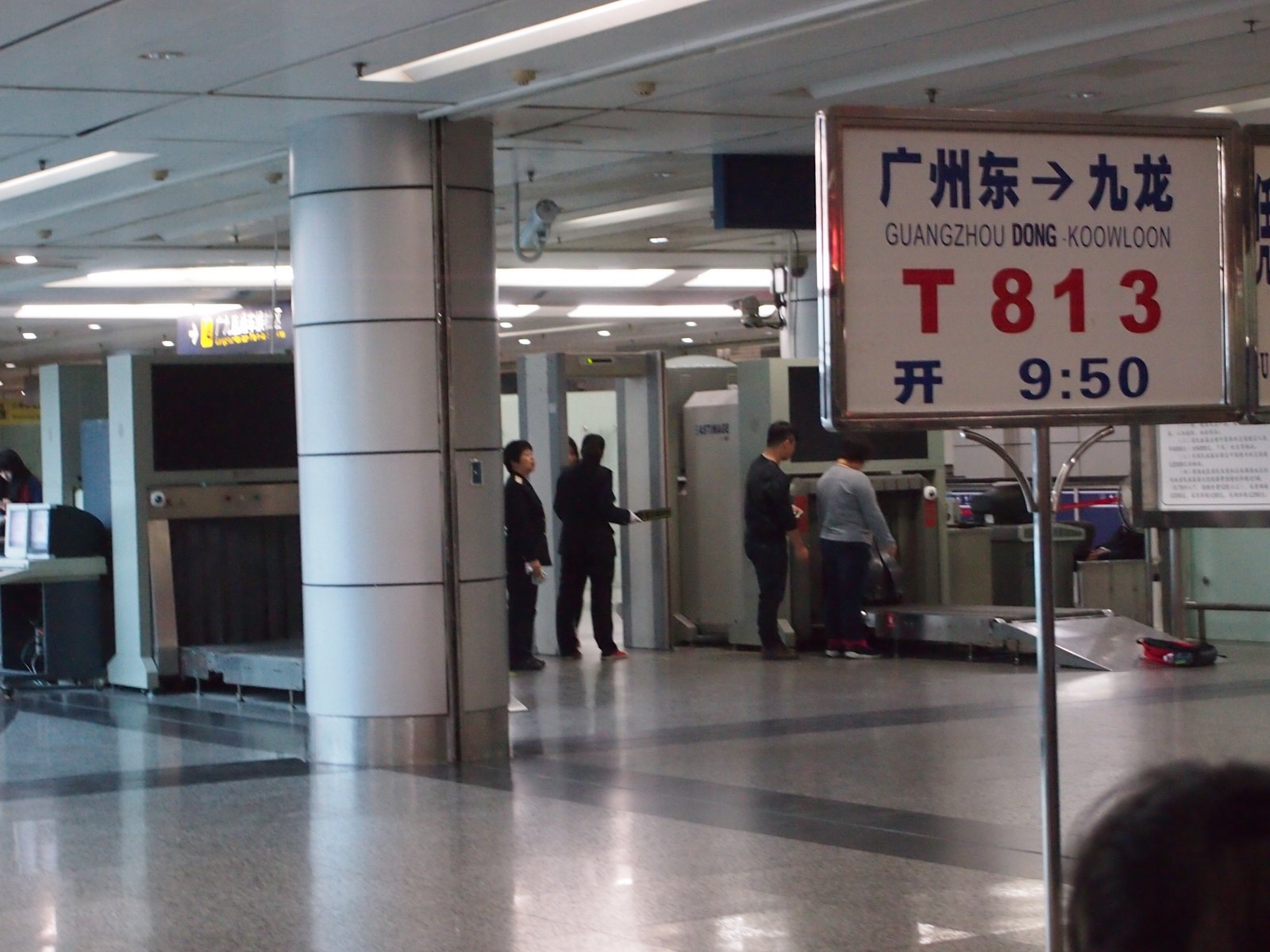
Waiting for the immigration gate to open. Come to think of it, this is my first time crossing a boarder on a train.

There are two kinds of trains between Guangzhou and Hong Kong. The China ones and Hong Kong ones.
Of course, I chose the China one!
Hong Kong trains use made-in-Japan carriages and it would be the same as any other ordinary train ride experiences.

I'm glad that the Soviet style uniforms are still alive!
I hope they won't "modernize" those communist-style uniforms because they are one of the tourist attractions for foreigners.
Although it's also true that British-style uniforms in Hong Kong do look good!

"Ruanzuoche"

Very comfortable.
I love the color of seats and the design of the carpet!
It would just be the same as any train anywhere in the world without those Chinese characteristics.

No more conductors distributing hot water with a big kettle! (Sayang!)
It would have been more environmentally friendly than distributing bottled water, which many passengers don't drink anyway.
In China, people USED TO bring their own cups. In other countries, people are JUST STARTING to do so for environmental concerns.
By the way, I was told off by this conductor for taking pictures in the train!

A much more modern and faster train that connects Guangzhou with Shenzhen.

Guangdong must be one of the best part of China. Clean and green!
Such a stark difference from typically arid and dusty landscape of the rest of mainland China!

Arrived in Shenzhen.
This ultra-modern city used to be a sleepy farming village until Deng Xiaoping came here in the early 80s.

Crossing the boarder! On the right is the China side.

The ultra-modern city landscape of China turns into a squeeky clean natural-park style countryside once the train enters Hong Kong.
In my opinion, one of the best legacy of the British rule in Hong Kong is the separation of commercial/residential areas with natural reserves.
If this was in Taiwan (or in mainland China for that matter), those green hills would already be teeming with fake-European-style residential towers, hot spring resorts, night markets and graveyards.

Arrived at Kowloon station (Hung Hom).
I realy like the traditional Chinese fonts used for signs in Hong Kong MTR. They are traditional, yet modern.

Hung Hom station looks like one of the more modern train stations in Europe. Big glass windows and metal roofs are really unsuitable for tropical weather and wastes a lot of electrcity for airconditioning.
But I think the European aesthetics are still very much alive in Hong Kong. And they have enough money to afford to look good, I think!

Friday, February 1, 2013
Trilingual medical personnel in Taiwan
Medical personnel in Taiwan are at least trilingual. At the physical theapy room in a hospital where I visit twice a week, the language I hear most often is Taiwanese Hokkien. This is because most of the patients are elderly. The therapists communicate with them in Hokkien, of course, but I can tell that many of the young therapists are not very fluent in it. They must have grown up speaking almost exclusively Mandarin like other young people in Taiwan, and received special training in Hokkien to deal with Hokkien-monolingual patients. When they converse with other therapists regarding something they don't want their patients to overhear, for example someone's medical condition, they switch to English (Another instance of the boundary between the Outer and Expanding Circles being blurred). This is normal because medical training in Taiwan heavily use English. Aside from this, many doctors and nurses can speak Japanese as well. I also know of some Filipino doctors practicing in Taiwan who are multilingual in this way. (They can speak Mandarin, Taiwanese-style Hokkien, as well as English, Filipino, Philippine-style Hokkien and perhaps even one more Philippine language!) I also know of a second-generation mainlander who had aspired to become a doctor in Taiwan, but gave up because of her failure to master Hokkien. It's difficult being a doctor in Taiwan and unable to speak Hokkien, because many patients are elderly.
Subscribe to:
Posts (Atom)